Skip to content
Home » Teaching Effectiveness » Instructional Strategies » Leverage the Testing Effect

Leverage the Testing Effect

When we ask students how they study, very common responses are reviewing notes and re-reading the textbook. This has been confirmed by researchers. In this study, rereading notes or the textbook was the most common study strategy, reported by 84% of students.The rationale behind this is that students believe they need to “put information into their brains” (what psychologists call “encoding”). What cognitive scientists will tell us is that human brains encode fairly quickly (encoding puts information into our short-term memory, which is why this strategy can have very short-term positive effects). However, repeated encoding does not efficiently lead to learning. Those same cognitive scientists will tell us that a much more effective way to learn (and move knowledge into long-term memory) is to actively and repeatedly attempt to retrieve information, with immediate feedback. One of the very best ways to practice retrieving information is to take a test. This is called “the testing effect.”
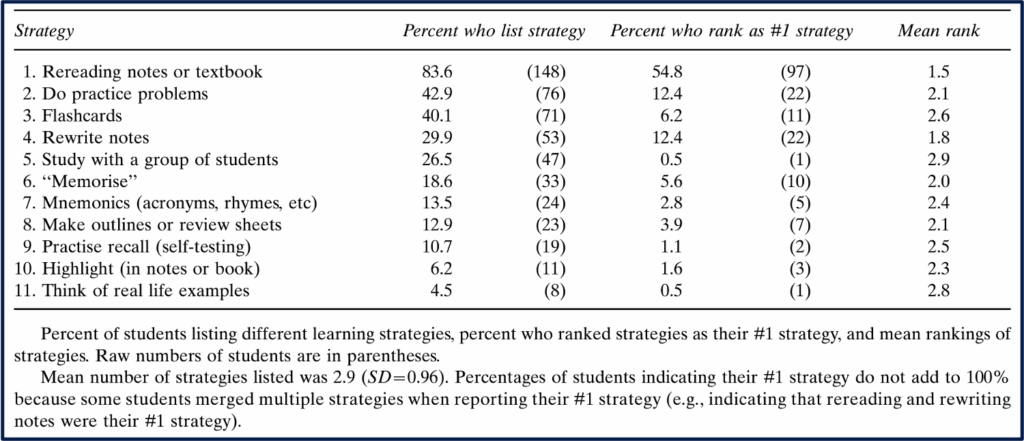
A table from a scholarly article showing a list of study strategies by percent of students who ranked a strategy as #1, with "rereading notes or textbook" in the first spot with 83.6% of students listed the strategy and 54.8%. listing is as their #1 strategy.
Reference: Karpicke, J. D., Butler, A. C., & Roediger, H. L. (2009). Metacognitive strategies in student learning: Do students practice retrieval when they study on their own? Memory, 17(4), 471-479. https://doi.org/10.1080/09658210802647009

In a lab study, when students prepared for tests with multiple choice and short-answer quizzing, they performed better on final tests, in both multiple choice and short-answer formats. In classroom studies, performance on a final test is strengthened when preparatory quizzing uses short-answer questions with immediate feedback. Spacing quizzing over time (called “spaced retrieval practice”) increases efficacy.
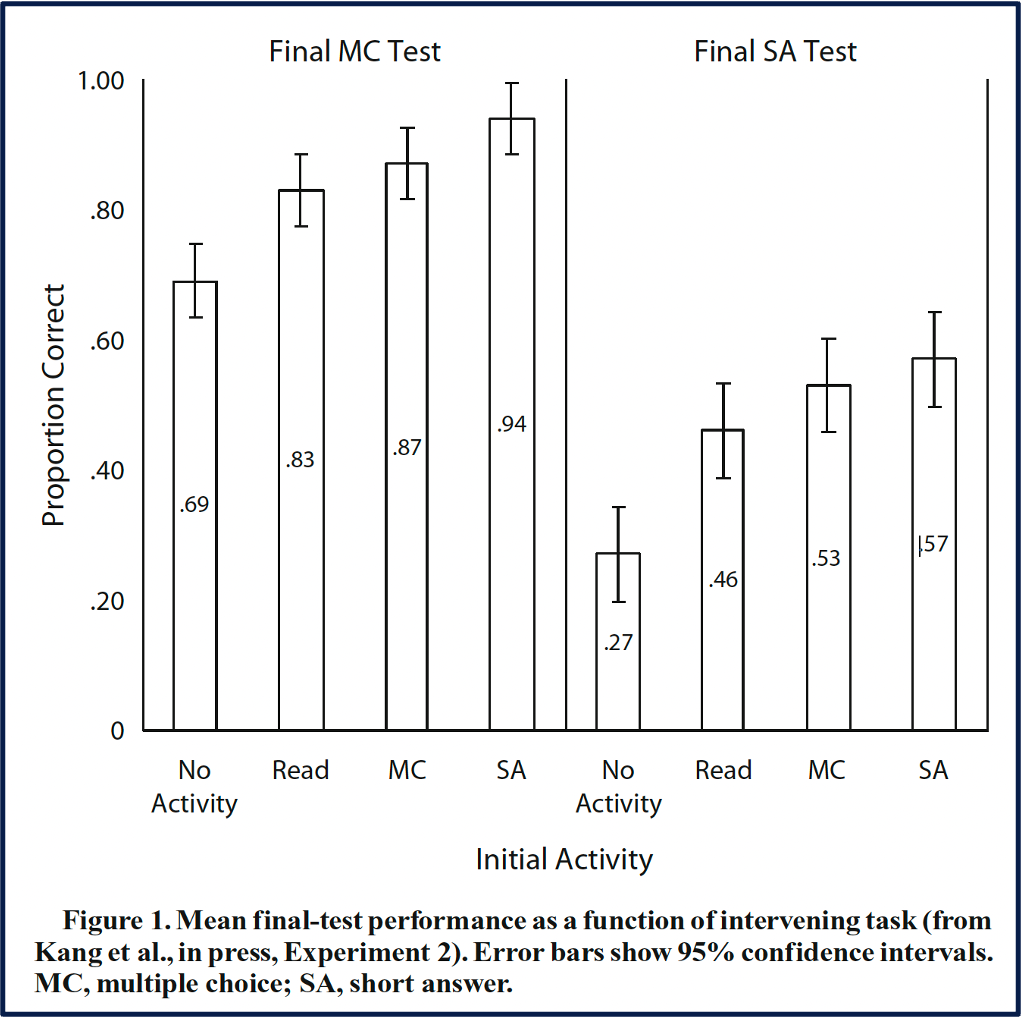
A graph showing the proportion of  correctly answered questions on multiple choice and short answer tests based on mode of preparation (no activity, reading, multiple choice questions, and short answer questions). In both modalities of tests, the best preparations were multiple choice and short answer quizzing.
Reference: McDaniel, M., Roediger, H., & McDermott, K. (2007). Generalizing test-enhanced learning from the laboratory to the classroom. Psychonomic Bulletin & Review, 14(2), 200-206. https://doi.org/10.3758/BF03194052

Roediger et al. (2011), researchers engaged in the science of memory and learning, have identified 10 benefits of testing:

  1. Retrieval aids later retention
  2. Testing identifies gaps in knowledge
  3. Testing causes students to learn more from the next study episode
  4. Testing produces better organization of knowledge
  5. Testing improves transfer of knowledge to new contexts
  6. Testing can facilitate retrieval of material that was not tested
  7. Testing improves metacognitive monitoring
  8. Testing prevents interference from prior material when learning new material
  9. Testing provides feedback to instructors
  10. Frequent testing encourages students to study

Can you identify a benefit that makes you think a little differently about how you might use testing in your teaching?

Students are empowered when they learn about The Testing Effect. You might even want to have them read a study by McDaniel, Roediger, & McDermott (Generalizing Test-Enhanced Learning from the Laboratory to the Classroom). As you and your students shift mentality about tests from high-stakes assessments to incredibly effective learning tools, you will likely see shifts in both confidence and performance.

Provide low-stakes quizzes as learning, not evaluation, tools.

Repeat content from previous units in quizzes throughout the semester to increase long-term retention.

Game shows, such as Jeopardy can be an engaging way for students to take a quiz. You can assign this as homework to complete independently or you can have students work in small teams for an in-class gameshow activity.

Create homework assignments where students write their own quizzes (they can swap with a classmate to practice). Quiz questions make great “entrance tickets” to start a class session and hold students accountable.

Agarwal, P. K., Karpicke, J. D., Kang, S. H. K., Roediger, H. L., & McDermott, K. B. (2008). Examining the testing effect with open‐ and closed‐book tests. Applied Cognitive Psychology, 22(7), 861–876. https://doi.org/10.1002/acp.1391

Kang, S. H. K., McDermott, K. B., & Roediger, H. L. (2007). Test format and corrective feedback modify the effect of testing on long-term retention. European Journal of Cognitive Psychology, 19(4–5), 528–558. https://doi.org/10.1080/09541440601056620

Karpicke, J. D., Butler, A. C., & Roediger Iii, H. L. (2009). Metacognitive strategies in student learning: Do students practise retrieval when they study on their own? Memory, 17(4), 471–479. https://doi.org/10.1080/09658210802647009

McDaniel, M. A., Roediger, H. L., & McDermott, K. B. (2007). Generalizing test-enhanced learning from the laboratory to the classroom. Psychonomic Bulletin & Review, 14(2), 200–206. https://doi.org/10.3758/BF03194052

McDermott, K. B., & Zerr, C. L. (2019). Individual Differences in Learning Efficiency. Current Directions in Psychological Science, 28(6), 607–613. https://doi.org/10.1177/0963721419869005

Roediger, H. L., & McDermott, K. B. (2018). Remembering what we learn. Cerebrum. http://resolver.scholarsportal.info/resolve/15246205/v2018inone/nfp_rwwl.xml

Roediger, H. L., & Butler, A. C. (2011). The critical role of retrieval practice in long-term retention. Trends in Cognitive Sciences, 15(1), 20–27. https://doi.org/10.1016/j.tics.2010.09.003

Roediger III, H. L., Putnam, A. L., & Smith, M. A. (2011). Chapter One—Ten Benefits of Testing and Their Applications to Educational Practice. In J. P. Mestre & B. H. Ross (Eds.), Psychology of Learning and Motivation (Vol. 55, pp. 1–36). Academic Press. https://doi.org/10.1016/B978-0-12-387691-1.00001-6

Shaffer, R. A., & McDermott, K. B. (2022). The dual-process perspective and the benefits of retrieval practice in younger and older adults. Memory, 30(5), 554–572. https://doi.org/10.1080/09658211.2022.2027986

Yeager, D. S., & Dweck, C. S. (2020). What can be learned from growth mindset controversies? American Psychologist, 75(9), 1269–1284. https://doi.org/10.1037/amp0000794

Zerr, C. L., Berg, J. J., Nelson, S. M., Fishell, A. K., Savalia, N. K., & McDermott, K. B. (2018). Learning Efficiency: Identifying Individual Differences in Learning Rate and Retention in Healthy Adults. Psychological Science, 29(9), 1436–1450. https://doi.org/10.1177/0956797618772540