
Short Description:
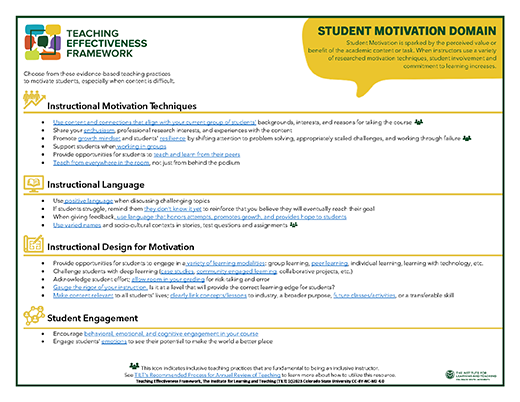
Sparked by the perceived value or benefit of the academic content or task. When instructors use a variety of researched motivation techniques, student involvement and commitment to learning increases.
Details for Implementation
When students are intrinsically motivated, they are more likely to engage in deep learning, less likely to be academically dishonest, and more likely to persist in their education.





Establish an audio and video presence in your online and hybrid courses to help your students feel comfortable with you. View this video from Dr. Julie Taylor-Massey for inspiration.
Use the self-reflection rubric as you consider your own teaching practice and use of instructional strategies. Download the file to get started.

Contemporary research in the field of student motivation and learning outcomes has been, and continues to be, robust. On this page, find summaries of several fundamental frameworks and theories that undergird motivation and outcomes. They include: attribution theory (Weiner, 1972); incremental vs. entity views of intelligence (Dweck, 1999); self-efficacy (Bandura, 1989, 1993, 1997); self determination theory (Ryan & Deci, 2000); and expectancy value framework (Eccles, et. al., 1983).
In general, these theories and frameworks attend to achievement motivation, i.e., those psychosocial constructs connected with the degree to which students engage in tasks and activities related to learning and demonstration of learning.
Attribution Theory
To what does a learner attribute success or failure? Attribution theory (Weiner, 1972) partitions these attributions into four components: (1) ability and (2) effort, each of which are personal (internal) domains, and (3) task difficulty and (4) luck, each of which are external to the individual. Further, “perceived causes like ability and task difficulty are consistent across contexts (stable), whereas effort and luck are more variable across contexts and potentially unpredictable (unstable). Moreover, effort and task difficulty can be influenced directly by the student and teacher (controllable), whereas current ability and luck cannot (uncontrollable)” (Hulleman et.al., 2016, pp. 247-248).
To harness the impact of these components:
- Pay attention to your language. Limit use of “good luck” and increase acknowledgement of effort.
- Structure your class so that effort is honored.
- Help students with subject specific study skills; help them know how to work smarter, not just harder.
- Encourage study groups; some students feel they must study alone and that is not true.
- You may consider using exam wrappers to assist students in self reflection about their exam preparation and results.
What implications does attribution theory have for your learning environment? If students believe that their success is influenced by uncontrollable factors such as luck, they will be less motivated to put forth appropriate effort for a task or an assessment. Further, students who ascribe their success to an inherent fixed ability, may downshift their effort or engage in self talk reinforcing the perception that they aren’t capable. It is possible that a poor grade on an assignment will reinforce this belief. Dweck’s work (1998) on growth mindset is related to the self-ascribed beliefs individuals’ have about their capabilities as well as their attitude toward set-backs and failure.
Your role as an instructor affords you the opportunity to use language and strategies that support effort. Emphasizing effort in your comments to students such as “congratulations on the improvement in your most recent essay draft” shows that student effort is a driving factor for success. Although we all do it, saying “good luck” before a test is counterproductive because it overtly or subliminally suggests that luck will influence a performance.
Academic Self-Efficacy
Self-efficacy influences academic motivation, learning, and achievement (Pajares, 1996). Self-efficacy is characterized by how one feels about themselves and their abilities to perform in domain-specific contexts. Foundational work in this social cognitive perspective, initiated by Bandura (1986) and sustained by myriad scholars, provides us with the understanding of how individuals come to believe they are capable. Contemporary research often examines how the environment impacts self-efficacy.
Although all students benefit from increased academic self-efficacy, some demographic groups’ needs are particularly noteworthy. Eddy and Brownell’s (2016) meta-analysis of self-efficacy for women in STEM provides evidence that women enter higher education with lower self-efficacy in STEM than men. Further, “these measures [self-efficacy, science identity, and belonging] have been shown to be correlated with achievement (Eddy & Brownell, 2016).”
There are four constructs that undergird self efficacy, and each can be impacted by you and the learning environment. Those four are: (1) mastery experiences, (2) vicarious learning, (3) verbal persuasion and (4) emotional and physiological states. Simply put, we feel more positive about our ability to perform in a specific domain if we have already been successful.
Self Determination Theory (SDT)
Ryan and Deci’s (2000) research on self determination theorizes that human motivation is based in the human condition to grow and develop competency. SDT posits that there are three fundamental psychological needs related to motivation: (1) the need for competence, (2) the need for autonomy, and (3) the need for relatedness. Further, when educators fulfill these three, students become more motivated, regulate their learning, and perform better (Niemiec & Ryan, 2009).
Competence
The need for students’ competence can be supported by learning challenges at the appropriate level for growth. Vygotsky (1978) described Zone of Proximal Development (ZPD) as “the distance between the actual developmental level as determined by independent problem solving and the level of potential development as determined through problem solving under adult guidance or in collaboration with more capable peers” (p. 86). Choosing appropriately scaled challenges for your students to develop competence (along with your guidance) is a motivator for students.

Autonomy
You can support students’ need for autonomy by providing them with some amount of choice to demonstrate mastery. Where possible, ask your students for input on the course content. Recognize that your adult learners and many younger undergraduates already exhibit autonomy in other aspects of their lives. Consider how those additional expectations for student responsibilities outside your learning environment can be accommodated, and even leveraged to encourage motivation, as you design your course.
Relatedness
You are supporting relatedness when your students can make meaningful connections to the content and the tasks asked of them. If your lived experience is dissimilar from your students’, you will want to think about how you can bring relevancy more to the forefront. Are you representing a variety of scholars’ history and demographics in your field? Are you using contemporary technology that is relevant to how students learn now? Consider conferring with your students (current and former) and colleagues in your field for ideas as you examine the course for relevancy.
Instructional Language
Instructional language refers to the frequency and quality of motivational and inclusive language used during class. At its best, high quality instructional language includes all students, encourages students, honors effort, and demonstrates belief in student abilities.
Research Based Motivation Techniques
Student involvement and commitment to learning increases when an instructor uses a variety of research-based motivation techniques during every class. Fostering an atmosphere that is engaging, open and positive will help students find personal meaning and value in the material you present.
Instructional Design for Motivation
Faculty can motivate students to engage in course content by varying teaching strategies and using activities that engage students in deep learning. Remember, your motivation is contagious! Faculty who exhibit enthusiasm for the learning experience, the material, and student success will help bolster students who experience challenges with the content.
Expectancy Value
The expectancy value framework (Eccles et al, 1983) builds on deep literature bases in both expectancies and value research. In brief, the expectancy value framework brings together students’ perceptions of (or expectancy for) being able to complete a task and the value ascribed to spending effort to master or complete a task. These two together form the motivation for individuals to engage with learning tasks. All decisions on whether to be motivated to engage with a task inherently include an evaluation of the cost for the engagement. What would one miss out on if time and attention were directed to something else?
As you think about this framework and implications for your students, consider how you could increase student expectancies for mastery, increase students’ perceptions of the value of your course work, and be aware of the costs students may balance in this analysis.
You might share your professional research interests and experiences: Why is the content important to you? What are your stories about working in this field of study? It’s important for students to see the relevance of the materials as it pertains to their future plans. Clearly link concepts/lessons to industry or a broader purpose, future classes/activities, or other transferable skills that are used in the field. Another relevancy-based strategy is to challenge students with deep learning (case studies, community-based learning, collaborative projects, etc.).
If you and your students have developed a strong relationship and you have helped students understand why your course is important to them, you will likely find that they engage deeply with you and their learning.belonging for students with modest incomes by making them feel like equal members of the community (Fernández et al., 2023).