Skip to content
Home » Teaching Effectiveness » Curricular Alignment » Fink’s Significant Learning » Useful Verbs for Fink’s Taxonomy of Significant Learning

Useful Verbs for Fink’s Taxonomy of Significant Learning

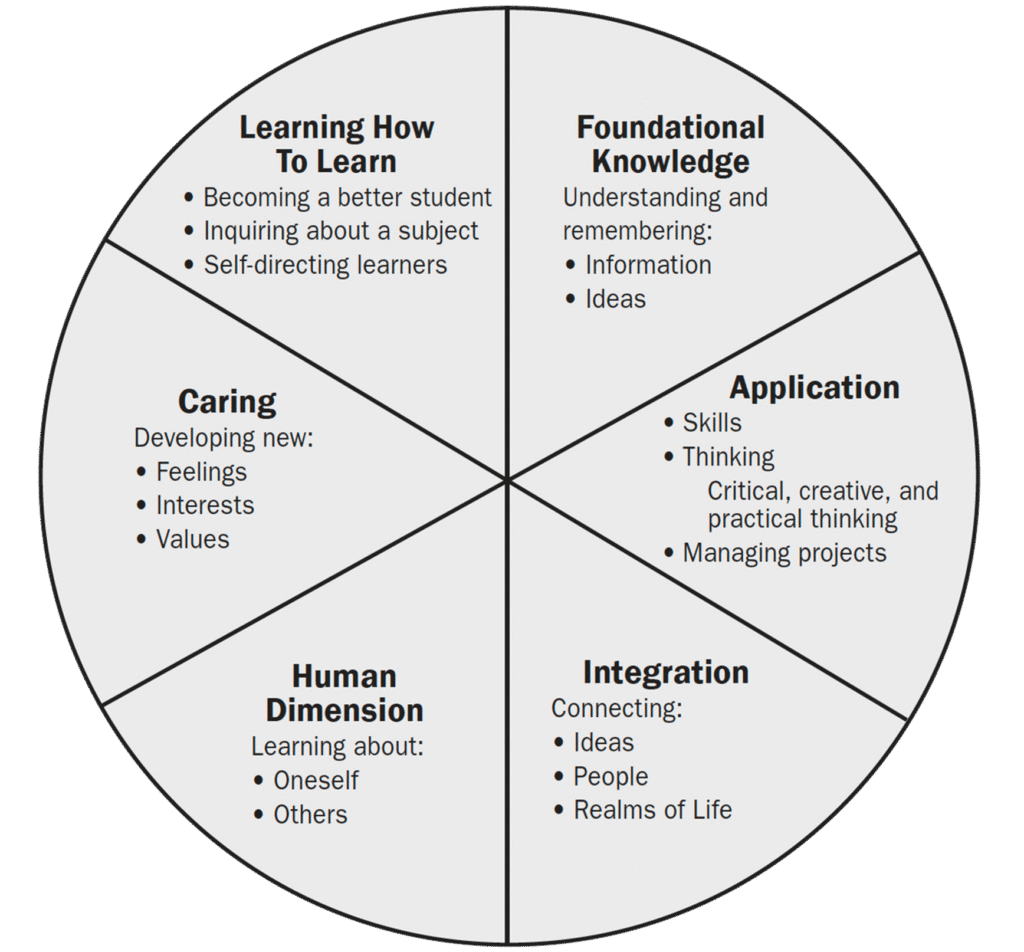
6 domains of Fink's significant learning taxonomy

Fink’s Taxonomy of Significant Learning provides a useful framework for considering the various dimensions of learning that can occur in a program, course, module, or class session.

This approach to program and course design encompasses the growth and development students encounter not just within the cognitive domain, but also related to emotional, physical, humanistic, metacognitive, and integrative learning.

When we write effective learning outcomes and program outcomes, we communicate to students the knowledge, skills, and dispositions they should be focused on developing within a learning experience. One key element to to writing these outcomes is a single, specific action verb, relevant to the level and type of learning students will be expected to demonstrate. Use the verb lists on this page, which were developed by Intentional College Teaching, to construct effective outcome statements.

What key information, ideas, and perspectives are important for learners to understand and remember?

Associate
Categorize
Classify
Clarify 
Compare
Contrast
Define
Describe

Explain
Give examples
Identify
Illustrate
Indicate
List
Name
Paraphrase

Predict
Recite
Recall
Recognize
Repeat
Restate
Summarize

What kinds of critical, creative, and practical thinking and skills are important for students to be able to do, learn, or manage?

Advise
Analyze 
Apply
Assess
Audit
Catalog
Categorize
Choose 
Classify
Compare
Contrast 
Debate 
Decipher

Deduce
Derive
Determine
Differentiate
Dissect
Distinguish
Evaluate
Examine
Formulate
Hypothesize
Infer
Interpret
Judge

Justify
Label
Locate
Measure
Organize
Predict
Propose
Query
Separate
Suggest
Test
Trace

Adapt 
Author 
Compose 
Construct 
Convert 
Create 

Design 
Develop 
Discover 
Envision 
Experiment  
Fabricate 

Imagine
Improve 
Refine
Reform 
Sketch 
Transform

Advise 
Apply  
Choose 
Conduct 
Coordinate 
Demonstrate 
Decide 
Determine  

Develop 
Diagnose 
Facilitate 
Guide 
Give evidence
Implement 
Manage 
Organize 

Plan 
Predict 
Prioritize 
Propose 
Select 
Strategize 
Supervise 
Solve

Conduct 
Demonstrate 
Execute 

Exhibit 
Perform 
Produce

Set up
Use

What connections should learners be able to recognize and make both within and beyond this course experience? 

Associate 
Combine 
Connect  
Contrast 

Compare  
Correlate 
Differentiate 

Link 
Relate 
Synthesize

What should learners learn about themselves and interacting with others? 

Acquire 
Advise 
Advocate for 
Be aware of 
Collaborate 
Communicate 
Cooperate 
Decide to 
Describe 
Demonstrate 
Educate 
Embody 

Empathize 
Express 
Feel confident 
Influence 
Initiate 
Inspire
Involve 
Lead 
Mediate 
Mobilize 
Negotiate 
Nurture 

Promote 
Reconcile 
Reflect upon 
Respect 
See oneself as 
Serve 
Share 
Show 
Suggest 
Support 
Take responsibility 

What changes in learners’ feelings, interests, and values are important? 

Agree 
Commit 
Decide 
Demonstrate
Develop 
Discover 

Explore 
Express 
Get excited
Identify 
Pledge 

Recognize 
Renew  
Share 
State 
Value

What should learners learn about learning, engaging in this inquiry, and becoming self-directed? 

Describe  
Construct 
Critique 
Identify resources 
Inquire 
Research 

Reflect upon 
Self-Assess 
Self-monitor 
Set goals 
Frame 

Generalize 
Identify 
Predict 
Take responsibility 
Transfer