New Opportunity Starting in Fall 2026!!
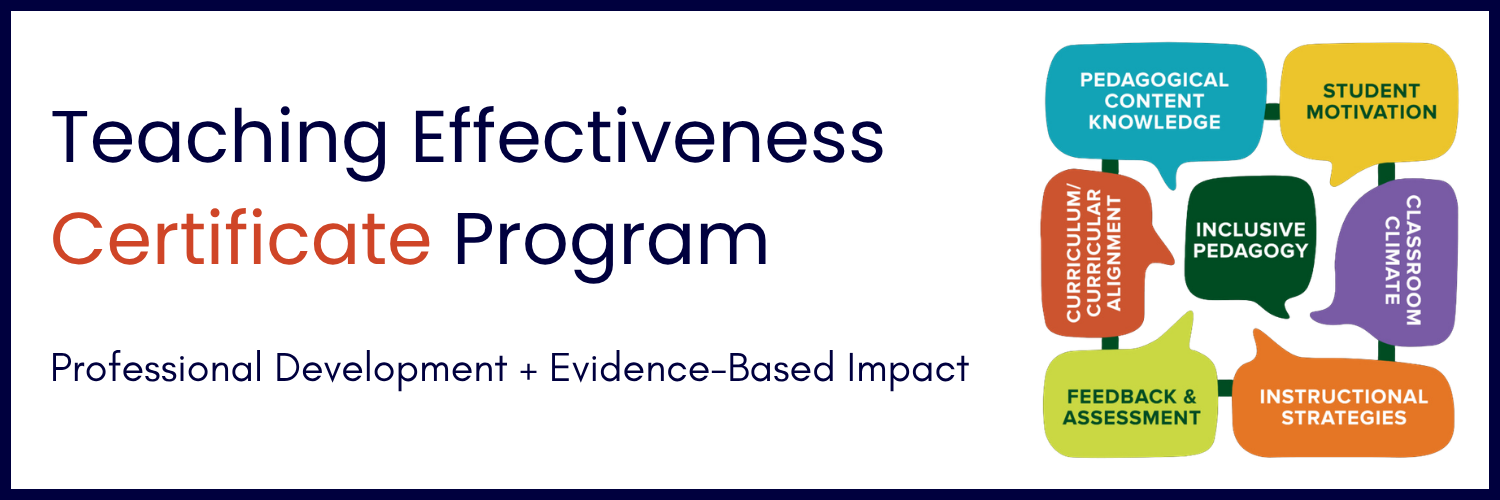
The Teaching Effectiveness Certificate Program is a voluntary professional development opportunity that provides recognition to instructors invested in growing their teaching practice. The certificate program provides a structure to engage in developing teaching effectiveness through implementation, self-reflection, and growth, grounded in the evidence-based teaching practices of the Teaching Effectiveness Framework (TEF).
Each year, the CTLI will offer a “depth” approach for a single domain. For 2026-27, the Teaching Effectiveness Certificate will be offered in the Student Motivation domain. Instructors will have opportunities to earn Domain Experience Units (DEUs) by:
- Participating in a professional development experience.
- Implementing a teaching change based on what they learned.
- Evaluating and reflecting on the impact of that change.
- Submitting a summary of the learning, efforts, and impact on student learning for approval; submissions will be evaluated against the Rubric for Post Implementation Reflection (see Step 4 below).
Any instructor who earns ten DEUs in the 2026-27 academic year will receive the Student Motivation Teaching Effectiveness Certificate.
The first step in the process is to attend a professional development activity. Different professional development experiences require different levels of effort. The CTLI will provide opportunities for instructors to earn Domain Experience Units (DEUs) in a variety of different ways. While participation in a professional development activity is the first step in the process, the certificate program is earned through implementation of teaching changes, not merely attendance at events and workshops.
| Professional Development Opportunity | Domain Experience Units |
|---|---|
| Year-Long Faculty Learning Community | 10 |
| Semester-Long Teaching Square | 07 |
| Summer Teaching Effectiveness Retreat | 03 |
| CTLI Book Group | 03 |
| Co-Develop/Co-Present a Workshop with the CTLI | 02 |
| Evidence-Based Change Implementation (related to Teaching Effectiveness Goals and/or Mid-Semester GIFT participation) | Substantial change: 06 Moderate change: 04 Minor change: 02 |
| Single Workshop | 01 |
The second step to earning DEUs is to implement new (or revise existing) research-based teaching practices and collect evidence on the impact the change had on student learning.
In general, we recommend you take the following steps:
- Set a teaching goal, based on the professional development you attended.
- Define specific strategies you will integrate into your teaching. Additionally, describe the results you’d expect to see, typically related to student learning and behaviors.
- Collect evidence of the impact of your teaching change, specifically, how students responded to the intervention you initiated. You may want to collect both direct evidence (example: artifacts of student learning) and indirect evidence (example: satisfaction survey) from your students.
To complete Step 3, evaluate the impact on student learning by reviewing the evidence collected. Consider what went well, how you know, and what you will revise as you continue to refine your teaching practice.
Finally, submit a Post-Implementation Reflection Form [VSCS login required] to describe and reflect on the effectiveness of the teaching intervention and apply for DEUs.
Submissions will be reviewed using the reflection rubric. Participants must earn “Accomplished” in each criterion to earn DEUs. “Developing” reflections will be returned with specific feedback for revision. Submissions will receive a response within 10 business days.
Once you have earned 10 DEUs, you will receive your digital Certificate (sent to your VSCS email address) with 10 business days.
Rubric for Post Implementation Reflection
NOTE: The depth and/or breadth of your response should be in line with the length and intensity of the professional development experience. For example, an instructor taking a 1 DEU course might implement one new practice whereas an instructor taking a five DEU course might implement multiple practices or an in-depth revision to a course.
| Criteria | Accomplished | Developing |
|---|---|---|
| Implementation of Research-based Practices Describe the specific research-based practices (from the TEF) implemented in your teaching related to participating in this professional development. These changes might be new additions, or they may be extending or revising an approach you’ve been using. Please be specific. | Describes the teaching or planning technique in enough detail so that the reader knows exactly which technique(s) was implemented. Depth and breadth of implementation of new teaching practices is congruent with the length and intensity of professional development experience. | Briefly describes the teaching or planning technique(s) implemented. Needs more detail to be clear to the reader. |
| Impact on Students Describe how these specific research-based techniques impacted your students and/or class. Describe how students responded to these techniques. | Addresses what worked well and what didn’t work as well, openly and objectively. Gives specific details as to how most students responded to the implemented technique. | Begins to discuss the impact on class or students but needs more detailed analysis of what went well or not well regarding student response to the implemented technique. |
| Impact on Future Teaching Describe how these changes have impacted your beliefs related to learning & teaching. Describe how these changes/results will impact your future teaching AND/OR your next teaching goal. What are your next steps and when do you plan to make these changes? | Indicates through word choice and next steps a genuine effort to develop teaching using research-based practices. Includes specific and time-bound plans for future implementation. Includes general next steps that may or may not be connected to recommendations in the experience. | Does not indicate through word choice or next steps a genuine effort to develop teaching. Does not include specific nor time-bound next steps. |