Evidence-based teaching, both general and discipline-specific, relies on Scholarship of Teaching & Learning (SoTL – rhymes with “total”). This field, which emerged in the past several decades influenced by the ideas of Boyer (1990) and Bass (1999), has elevated teaching in higher education from a “sage on the stage” model focused primarily on the instructor to a more nuanced and learning-centered practice. Teacher-scholars not only reflect individually on their teaching challenges and successes, but engage in rigorous pedagogical research and the peer-review process to establish and evolve best practices. In a nutshell, SoTL is “a comprehensive and systematic approach to investigating, improving, and sharing knowledge about teaching and learning in higher education.”
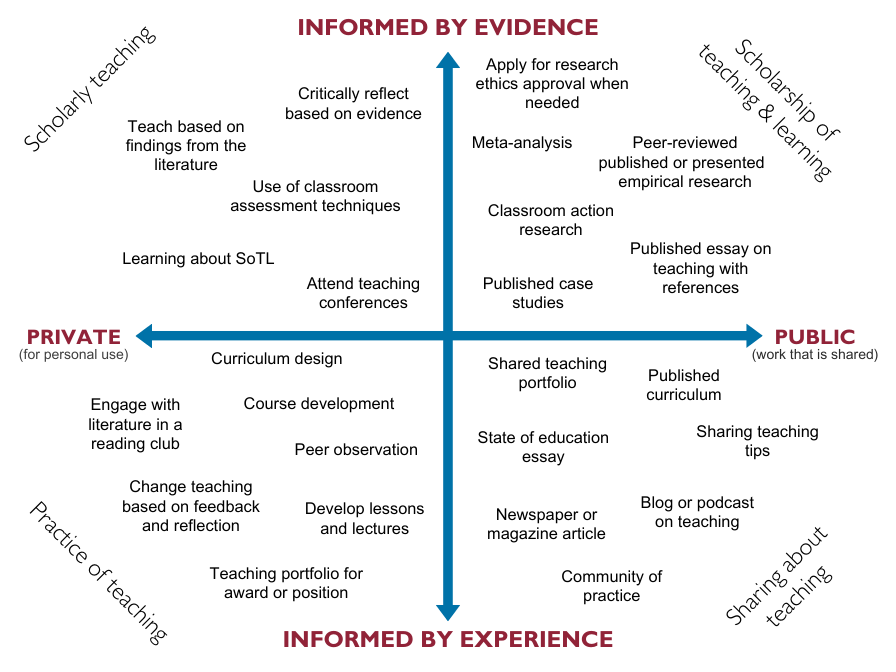
Image Description:
A quadrant diagram illustrating different dimensions of teaching and learning, categorized by their orientation towards evidence or experience, and whether they are shared publicly or kept private. The vertical axis is labeled “Informed by Evidence” at the top and “Informed by Experience” at the bottom. The horizontal axis is labeled “Private (for personal use)” on the left and “Public (work that is shared)” on the right. Each quadrant contains activities or concepts related to teaching and how it is improved and/or shared. The top left quadrant reflects scholarly teaching and includes items like “Teach based on findings from the literature” and “Use of classroom assessment techniques.” The top right quadrant represents the scholarship of teaching and learning, with items like “Peer-reviewed published research” and “Published essay on teaching.” The bottom left quadrant focuses on the practice of teaching with terms like “Curriculum design” and “Peer observation.” The bottom right quadrant involves sharing about teaching, including “Published curriculum” and “Blog or podcast on teaching.”
SoTL encompasses:
- Sharing findings widely to advance understanding of effective teaching in higher education.
- Rigorous inquiry into teaching and learning processes across disciplines.
- Applying evidence-based practices to enhance student learning outcomes.
- Collecting and analyzing data on teaching effectiveness and student achievement.
- Reflecting critically on pedagogical approaches and their impact on diverse learners.
SoTL embraces diverse methodologies, from discipline-based education research to action research, unified by a shared commitment to transforming teaching and learning through evidence-based, systematic inquiry. This holistic approach fosters a culture of continuous improvement in higher education, where insights from various fields inform pedagogical innovations and the science of learning enriches teaching practices across disciplines.
Explore SoTL and other teaching publications
Teaching can be a lonely activity, which is why the CTLI provides opportunities through workshops, book groups, and consultations to talk with colleagues and staff. Dialoguing with others can be reinvigorating and ignite joy in teaching, even when faced with thorny challenges. These kinds of conversations can also occur with colleagues around the nation and world via published SoTL research.
Additionally, investigating resources that are specific to your discipline plays an important role in remaining current in your field and identifying opportunities to update curriculum, activities, and assessments. In some cases, if the changes in a field are particularly rapid, it could even justify updates to student learning outcomes at the program level. Currency in a discipline can also enhance student learning when new concepts are integrated into authentic assessments that make them feel better connected to their future profession. In addition to your own independent research, the resources below could be helpful in supporting your efforts in advancing your pedagogical content knowledge.
VSCS Libraries
The VSCS Libraries are a valuable source of SoTL resources, in particular their Professional Development & Teaching Resources page. The top of the page includes SoTL books and ebooks organized by subject. The bottom portion of the page includes teaching-focused journals organized by program area.
External Sites and Databases
In addition to our own internal resources and your own field-based professional development, the sites below could also be useful as supplemental sources of discipline-specific information.
- Cornell University – Open Educational Resources at Cornell: Discipline Specific
- Kennesaw State University – Teaching Journals in Higher Education
- Northern Arizona University – OER by Discipline
- University of San Francisco – Discipline-Specific Open Educational Resources
Teaching Podcasts
Sometimes we don’t have time to read a book, but a podcast can be a great accompaniment to a walk or a commute. Here are a few reliable and updated podcasts focused on university teaching that may appeal to you:
Consider doing your own SoTL research
Teaching and research go hand-in-hand. The addition of SoTL to your research activities can enhance your RPT dossier, in both the teaching and scholarship categories while deepening or improving student learning and success. As with all research involving human subjects, work with the IRB to ensure ethical and procedural adherence to standards (Martin, 2013).
If you are interested in getting started with SoTL, check out some of the resources in the VSCS library:
- Applying the Scholarship of Teaching and Learning Beyond the Individual Classroom
- The Scholarship of Teaching and Learning : A Guide for Scientists, Engineers, and Mathematicians
- The Contemplative Mind in the Scholarship of Teaching and Learning
- Going Public Reconsidered: Engaging with the World beyond Academe through the Scholarship of Teaching and Learning
- Scholarship of Teaching and Learning and Assessment: Advancing a Collaborative Model
References
- Bass, R. (1999). The scholarship of teaching: What’s the problem?, Inventio, 1(1), 1-9.
- Boyer, E. L. (1990). Scholarship reconsidered: Priorities of the professoriate. Jossey-Bass.
- Martin, R. C. (2013). Navigating the IRB: The ethics of SoTL. New Directions for Teaching and Learning, 136, 59–71. https://doi.org/10.1002/tl.20076
The section “What is the Scholarship of Teaching & Learning (SoTL)?” on this page is partially adapted from Faculty Research: Scholarship of Teaching and Learning, CC BY 4.0.