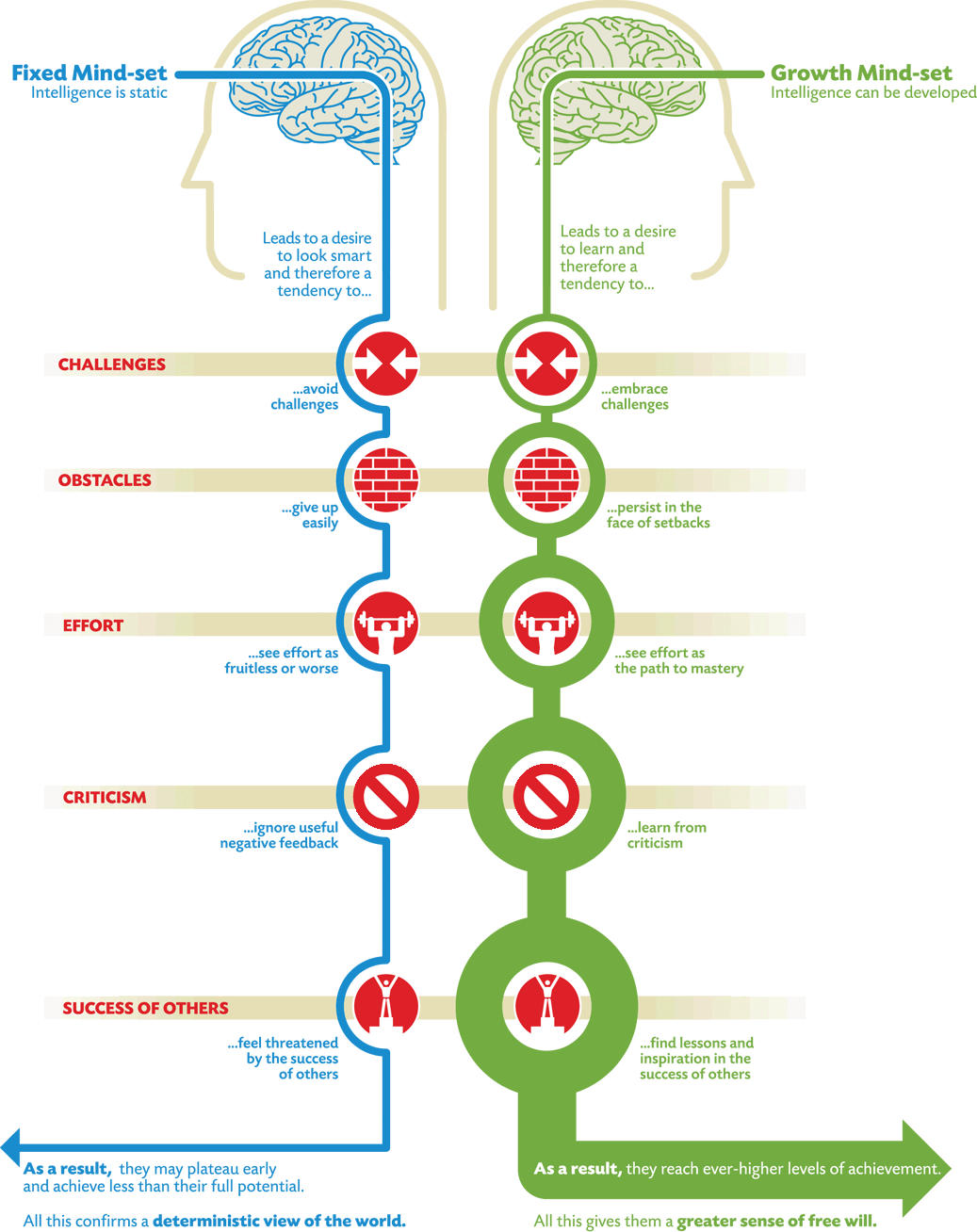
Psychologist Carol Dweck (2016) has studied mindset in students. This is a powerful framework for helping students understand their habits of mind and their approaches to activities that feel difficult.
Reference: Dweck, C. S. (2006). Mindset : The new psychology of success. Random House.
With a fixed mindset, students believe that their talents and intellect are fixed and their performance is predetermined (e.g., “Of course I failed that test – I’m not a math person”). When we operate with a fixed mindset, failure is confirmation of this personal weakness.
When we operate with a growth mindset, we see failure as a learning opportunity (e.g., “I missed that question on the knowledge check quiz, but I can examine what I did wrong and discover strategies to improve”). When students are encouraged to learn from failure or mistakes by reflecting on what went well and what they could adjust or change, they are guided toward a growth mindset.
A growth mindset can counteract stereotype threat (Canning et al., 2022; Lee et al., 2024), a common source of imposter syndrome, in which people may have absorbed implicit messages about how they are expected to perform based upon some aspect of their identity and corresponding social stereotypes.
Have students watch short videos and read a popular news article to learn about mindset:
- What is Growth Mindset? (~3 minute video)
- Neuroplasticity(~2 minute video)
- Carol Dweck’s TED Talk — The Power of Believing that You Can Improve (~10 minute video)
- Growth Mindset: Clearing Up Some Common Confusions (a short article)
Then have students discuss with each other how they have experienced mindset in life and/or education. You could also have them explore scenarios and ask how a student with a fixed mindset or a growth mindset might approach the situation.
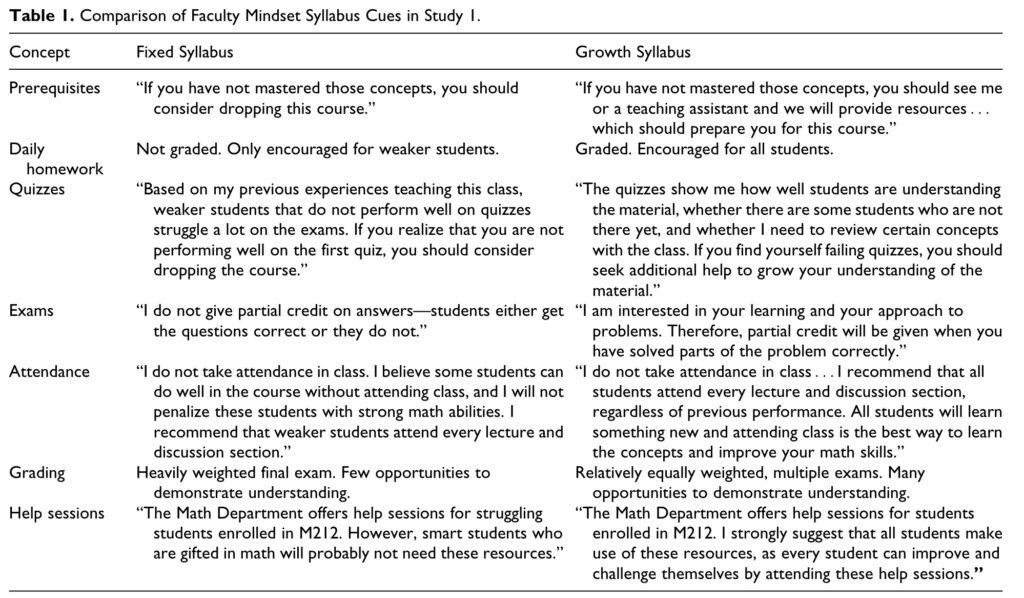
Faculty also benefit from examining their mindset about students and how that perspective may be communicated in ways that are harmful or helpful. For instance, researchers (Canning et al., 2022) conducted a study that exposed a “causal relationship between perceived faculty mindset beliefs, the psychological experience of stereotype threat, and women’s performance in STEM” (p. 9). Simple changes to syllabi language or spoken words in the classroom, then, can positively influence student performance, especially those who might typically be marginalized in a particular environment or discipline, when they shift from a fixed mindset tone to a growth mindset tone (Table 1).
Being human and sharing examples of your own encounters with mindset can be motivating for students. For instance, if there is a particularly challenging concept that it took you significant effort to master, share with students your process, effort, and how you combatted any instincts toward a fixed mindset. Often fixed mindset shows up in the “self-talk” that we express in our heads as we encounter something difficult. Share with students how you recognize and reframe fixed mindset self-talk to encourage your own growth mindset.
If you are asked a question for which you don’t have a ready answer, be honest and explain to students the process you’ll pursue to respond with confidence. In the next class, show them how you learned the information and how you used a growth mindset to persist if you encountered any difficulties.
The college classroom is a really excellent place to take risks, fail, and learn from errors. Often, students may avoid taking intellectual risks for fear of such failure affecting their grade. When faculty structure their classes to include no- or low-stakes opportunities and encourage students to stretch their capacities with a growth mindset, students are likely to engage in deep learning. When these low-stakes opportunities are scaffolded into a summative assignment that may be higher stakes, they have an opportunity to reflect on their mistakes and demonstrate further learning.
Canning, E. A., Ozier, E., Williams, H. E., AlRasheed, R., & Murphy, M. C. (2022). Professors who signal a fixed mindset about ability undermine women’s performance in STEM. Social Psychological and Personality Science, 13(5), 927–937. https://doi.org/10.1177/19485506211030398
Dweck, C. S. (2006). Mindset : The new psychology of success. Random House.
Lee, A. A., Totonchi, D. A., Priniski, S. J., Lee, M., Perez, T., & Linnenbrink-Garcia, L. (2024). Do performance goals and fixed mindset explicate the relations between stereotype threat and achievement? Examining differences between racially marginalized and White students in STEM. Learning & Individual Differences, 115, N.PAG. https://doi.org/10.1016/j.lindif.2024.102525
Yeager, D. S., & Dweck, C. S. (2020). What can be learned from growth mindset controversies? American Psychologist, 75(9), 1269–1284. https://doi.org/10.1037/amp0000794