GenAI in learning environments is a complicated matter. A simple web search will surface advice that genAI can be both harmful and helpful for learning. Durable skills such as metacognition, critical thinking, and information literacy are even more important for students to develop, as AI-generated content proliferates. At the same time, genAI can help students with organizing, brainstorming, and developing study aids.
Two approaches to take with students are to teach about genAI and to teach with genAI.
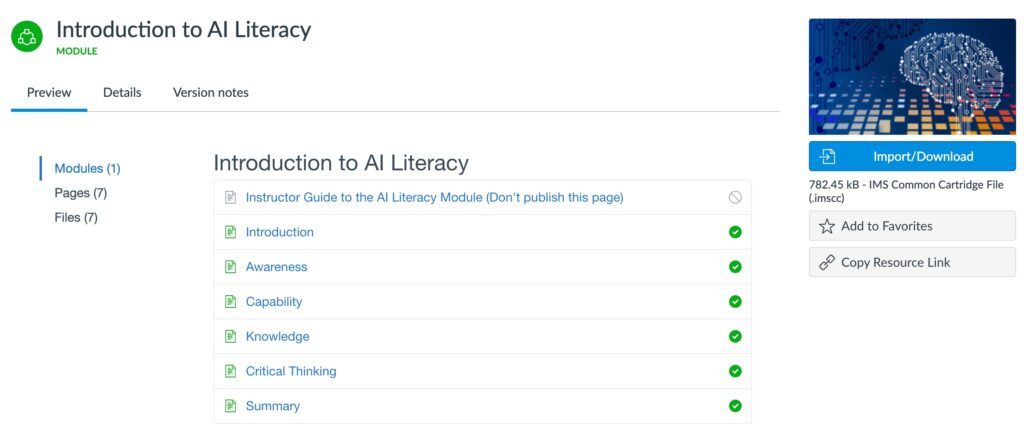
The CTLI has customized an Introduction to AI Literacy guide as a module that you can import into your Canvas course. This module is distributed under a Creative Commons NC-SA license; please describe any changes you make and include the CC-NC-SA license.
To preview and/or import the module, follow these steps:
- Login to Canvas (https://vsc.instructure.com) using your VSC credentials in your default web browser – you must do this step first to avoid a generic login prompt
- After logging in to Canvas, access the Introduction to AI Literacy module in Canvas Commons.
- Preview the contents by clicking on any module.
- Click the Import/Download button on the right side (under the thumbnail picture) and choose the course into which you wish to place the module.
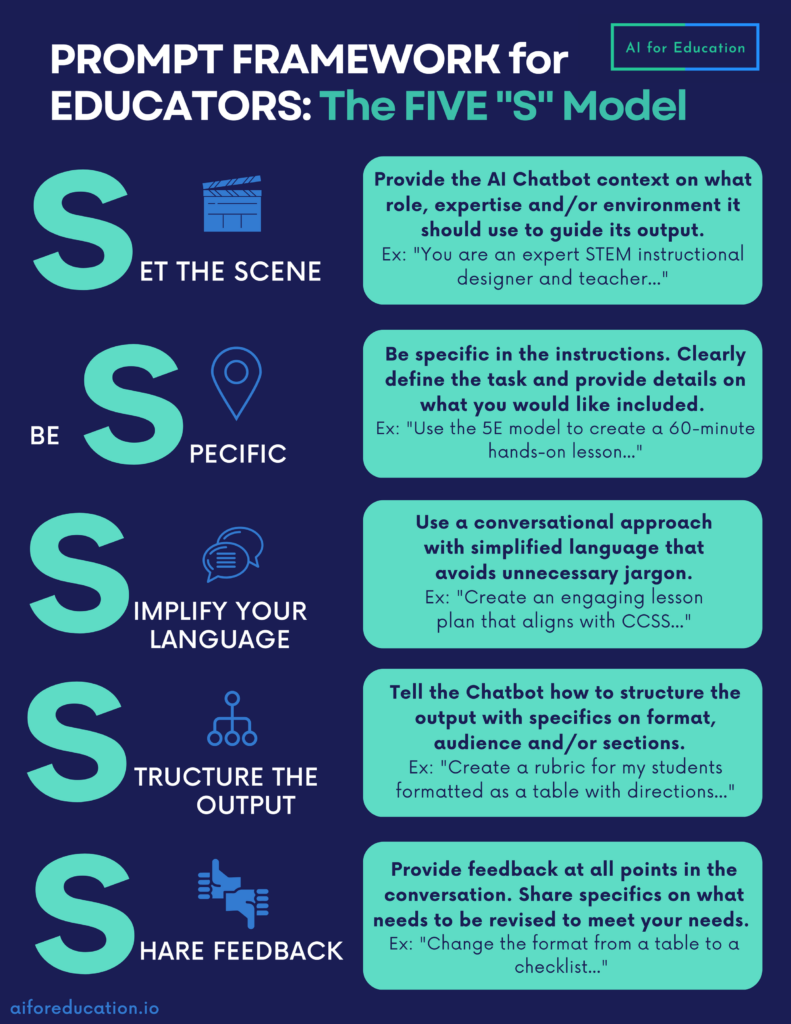
Additionally, AI for Education has developed resources for educators, including these two infographics that use simple mnemonics to coach students on responsible use of AI and effective prompt engineering. If you are teaching about genAI, these are simple strategies to help students learn to use genAI.
![An infographic using the mnemonic EVERY to encourage responsible use of AI. E stands for evaluate, V stands for Verify, E stands for Edit, R stands for Revise, and Y stands for You [are responsible].](https://ctli.vermontstate.edu/wp-content/uploads/2024/01/HowtoUseAIResponsiblyEVERYTimeInfographic-791x1024.png)
Teaching with genAI will likely require modifying or creating new assessments, assignments, and in-class activities. These compendiums (The Assessment Menu, 101 Creative Ideas Booklet, and ChatGPT Assignments to Use in Your Classroom Today) are three places to explore ideas. There are more suggestions (including discipline-specific) in the Additional Resources section.
The Assessment Menu
The Assessment Menu provides you with different options to consider when making changes to your assessment, including 40 different cards. Each card illustrates an idea for an assessment that either engages students directly with AI or for which AI tools find it difficult to generate a response. The suggestions here are starters for consideration and application within your discipline. Issues of access, equity and transparency with students need to be considered if using AI is an integral part of an assessment task. We need to be attuned to inclusive practice and provide options where appropriate.
Learning outcomes and associated criteria will likely need review to reflect capabilities that graduates will need in an AI-enabled world. For this reason you may find entries such ‘emotional intelligence’ or ’contextual intelligence’ that fit well with components of Fink’s Significant Learning framework including the Human Dimension and Caring.
The Assessment Menu is licensed under a CC-BY-NC-SA license.
101 Creative Ideas to Use AI in Education
This first compendium of ideas for incorporating AI into assessments and learning activities was crowd-sourced from around the globe. As educators experiment with possibilities for using AI to promote student engagement and learning outcomes, these strategies will be refined and expanded.
This booklet is licensed under a CC-BY-NC-SA license.
ChatGPT Assignments to Use in Your Classroom Today
Authors’ introduction: If we adopt the idea that the mindsets of instructors and students alike must change and accept that some form of AI fluency is a necessary desirable component of the curriculum, then their greatest need is assistance with the implementation of these concepts. Thus, we provide extensive examples of assignments that can be used in class or as homework. These ideas for assignments, and the principles that underlie the need for them, form the heart of this volume, and indeed make up the vast majority of its contents. Each example starts with the actual assignment to give to students before also offering explanations for why the assignment is worthwhile and how to implement it.
This booklet is licensed under a CC-BY-NC-SA license.
- Discipline-specific Generative AI Teaching and Learning Resources
- Gallery of “Collections” of GenAI Instructional Support & Strategies
- How to Write Compelling Writing Assignments in a ChatGPT Age by James Lang
- Assigning AI: Seven Ways of Using AI in Class by Ethan Mollick
- AI Pedagogy Project – Assignments Collection
- The Learning with AI Initiative
- AI Hacks for Educators
- Internet Ethics Case Studies (several address AI)
- Critical Reasoning with AI by Mike Caulfield