October 2026 | Volume 4 | Issue 3 | Previous Issues
High Expectations for Learning
In 1987, Chickering & Gamson published their seminal article “Seven Principles for Good Practice in Undergraduate Education.” If you haven’t (recently) read it, we would recommend taking a few minutes to do so, as the roadmap they laid out almost 40 years later still rings true. On the first page of their article, the authors note:
Good practice in undergraduate education:
- Encourages contacts between students and faculty.
- Develops reciprocity and cooperation among students.
- Uses active learning techniques.
- Gives prompt feedback.
- Emphasizes time on task.
- Communicates high expectations.
- Respects diverse talents and ways of learning.
Chickering & Gamson also cautioned that the integration of all seven practices is important for amplifying the power of any one of them. In this teaching tip, we’re going to focus on the importance of communicating high expectations to students (#6) recognizing the interplay with the other principles.
For instance, Kirby & Thomas (2022) utilized three tools to measure instructor behavior, classroom climate, and classroom community. They found that students engaged with high academic expectations when they not only perceived instructor competence as high, but also when they found instructors to be “caring, supportive, competent, and good communicators” (p. 375), a clear indication of both reciprocity and respect.
High Expectations Require High Support
In 1995, Scott & Tobe explicated the importance of how to effectively help students achieve high expectations through goal-setting activities, expectations of active engagement, and deliberate institutional support, as contrasted with a “weeding out” mentality. They delineated actions faculty could take to encourage students’ pursuit of high expectations, all of which are still salient today:
- define transparent criteria for assessments,
- create space in the curriculum for students to tailor activities or assignments to their personal interests,
- use exemplars to model excellent work,
- provide prompt feedback,
- recognize that higher education is a good place to make mistakes in the pursuit of knowledge with built-in multiple attempts, and
- celebrate successes with students.
To set students up for success in meeting our high expectations, it can be helpful to consider Lev Vygotsky’s concept of the Zone of Proximal Development (ZPD), proposed initially in the 1930s and enduring today (Flair, 2026). If there is gap between a learner’s skills and knowledge, then no quantity of high expectations will help them immediately be able to do a task. In other words, the high expectations require alignment with students’ development, coupled with appropriate support. The ZPD is facilitated by guidance, practice, and feedback to help a student build a bridge between their existing skills and knowledge (when learners can do tasks unaided) and their future competency.
Learner can do unaided.
Zone of Proximal Development:
Learner can do with guidance.
Learner cannot do.
Each learner in your classroom may have a different ZPD for any particular content or material you are teaching. Formative assessment and scaffolding (Office of Curriculum, Assessment and Teaching Transformation, n.d.), in which you begin with high levels of support and then fade the amount of support over time to increase independence, thus become critical.
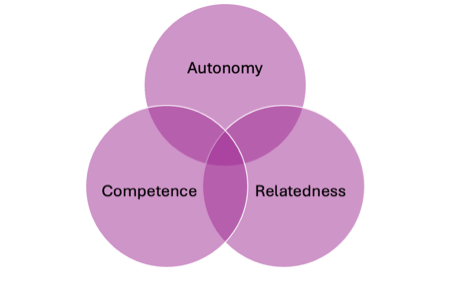
Additionally, Self-Determination Theory (SDT indicates that students will rise to the challenge (by ascribing value to a task and consequently being more motivated) when they when “experience supports for competence, autonomy, and relatedness” (Deci & Ryan, 2000, p. 74). Again, faculty have a role to play. Providing students with early positive feedback, embedding choices, and creating opportunities for collaboration can boost intrinsic motivation toward achievement of high externally-set expectations.
This emphasis on the responsibility of institutions and individual faculty for creating environments in which students can reach high expectations is echoed in Gannon’s (2023) more recent essay titled “Why Calls for a ‘Return to Rigor’ Are Wrong.” Gannon notes that rigor can fall into two categories: logistical and cognitive. He argues that higher education should be challenging (e.g., have high expectations for learning) while not enhanced by logistical barriers put up in the name of rigor.
Challenging Students Effectively
There are numerous ways to ensure that our classes are situated in students’ Zones of Proximal Development (ZPD), activate a sense of motivation and self-determination, and ensure positive learning challenge. We encourage you to try one or more of these approaches as you communicate high standards and support students to meet them.
- Communicate assignment expectations through transparently designed instructions and criteria, using exemplars when possible.
- Scaffold learning to boost students’ sense of competence and target their ZPD.
- Counter stereotype threat by teaching growth mindset.
- Implement team-based learning to increase relatedness.
- Learn one way to infuse choice in your courses (Nov 12 workshop) to increase autonomy.
If you would like assistance with any of these ideas, please don’t hesitate to reach out to us for a consultation!
References
Chickering, A. W., & Gamson, Z. F. (1987). Seven principles for good practice in undergraduate education. American Association for Higher Education Bulletin, 3-7. https://files.eric.ed.gov/fulltext/ED282491.pdf
Deci, E. L., & Ryan, R. M. (2000). Self-determination theory and the facilitation of intrinsic motivation, social development, and well being. American Psychologist, 55, 68 – 78.
Flair, I. (2026). Zone of proximal development (ZPD). Salem Press Encyclopedia.
Gannon, K. (2023, May 22). Why calls for a ‘return to rigor’ are wrong. The Chronicle of Higher Education. https://www.chronicle.com/article/why-calls-for-a-return-to-rigor-are-wrong
Kirby, L. A. J., & Thomas, C. L. (2022). High-impact teaching practices foster a greater sense of belonging in the college classroom. Journal of Further and Higher Education, 46(3), 368–381. https://doi.org/10.1080/0309877X.2021.1950659
Office of Curriculum, Assessment and Teaching Transformation. (n.d.) Scaffolding content. University of Buffalo. https://www.buffalo.edu/catt/teach/develop/build/scaffolding.html
Scott, R. A., & Tobe, D. E. (1995). Communicating high expectations: Effective undergraduate education. Liberal Education, 81(2), 38.

Lindsey Hood
Assistant Professor of Nursing, Williston Campus
Please tell us a little bit about your background and what brought you to VTSU.
I am a registered nurse, family nurse practitioner, and End of Life Doula. Over the course of my career, I have lived in Western NY, Cleveland, Los Angeles, and Eureka, CA. Four years ago, I moved from the Redwood Forest to the Green Mountains and am thrilled to join the community of nursing education.
Every nursing position I have held — from emergency to hospice to public health— has shaped my core identity. I am hoping to bring my experience and knowledge to the state university setting in order to help our future community of nurses flourish.
What are your favorite things about your field or discipline?
The nursing profession is vast because it comprises all the ways one could care for another human being. This means that nurses are needed in diverse fields, not usually considered such as architecture, forensics, and clinical research.
What is something you enjoy doing outside of work that helps you maintain a healthier work-life balance?
I’m a walker. I would be happy to walk everywhere if I could, even in the winter! And what makes a walk better? An audiobook! I am so grateful for the countless hours I have spent walking the Burlington Greenway while listening to a new and curious book. Solvitur ambulando! It is solved by walking!
As a new faculty member, what VTSU resources have been helpful in getting acclimated to the institution?
I was lucky to be hired with another new full-time faculty member in my department and on my campus. This has been the transition feel much less isolating and it is so nice to make new friends at work.
Are there any strategies you’ve employed to maintain student motivation in your courses?
In the ADN program, I am co-teaching NUR 2060 Transition to Practice which investigates major topics in the nursing profession. A consistent theme of this course is looking at the RN as an agent of change for themselves and others. Each discussion, I am prompting the students to dive more deeply into their own narrative and identity and then change their lens to a more global view.
Teaching Effectiveness Certificate
The Teaching Effectiveness Certificate Program is a voluntary professional development opportunity that provides recognition to instructors invested in growing their teaching practice. The certificate program provides a structure to engage in developing teaching effectiveness through implementation, self-reflection, and growth, grounded in the evidence-based teaching practices of the Teaching Effectiveness Framework (TEF).
Each year, the CTLI will offer a “depth” approach for a single domain. For 2026-27, the Teaching Effectiveness Certificate will be offered in the Student Motivation domain. Instructors will have opportunities to earn Domain Experience Units (DEUs) by:
- Participating in a professional development experience.
- Implementing a teaching change based on what they learned.
- Evaluating and reflecting on the impact of that change.
- Submitting a summary of the learning, efforts, and impact on student learning for approval; submissions will be evaluated against the Rubric for Post Implementation Reflection.
Any instructor who earns ten DEUs in the 2026-27 academic year will receive the Student Motivation Teaching Effectiveness Certificate.
Learn more on the Teaching Effectiveness Certificate webpage.
Teaching Squares
About Teaching Squares
A teaching square is a group of four instructors who agree to observe each other during a semester, using an agreed upon set of observation norms. It is designed to be a non-evaluative, supportive, and growth-based process. Participants set at least one personal teaching goal and then observe others before reflecting on their own practice.
Benefits of Joining a Teaching Square
In addition to reflecting on their own teaching practices, participants benefit from making connections with colleagues, sharing ideas, reigniting their passion for teaching, and having time set aside to discuss best instructional practices with supportive peers.
Teaching Square participants have the opportunity to earn Domain Experience Units (DEUs), which contribute toward earning a Teaching Effectiveness Certificate in the domain selected for that academic year.
How to Learn More and Sign Up
Learn more about the group process and how to sign up on the Teaching Squares Program webpage.
Mid-Semester Group Instructional Feedback Technique (GIFT)
Sign Up ASAP, as we are almost at mid-semester for 15-week classes!
Introduction to the Program
The Mid-Semester Group Instructional Feedback Technique, or GIFT, is an evidence-based practice that provides instructors with actionable feedback to improve the quality of a course. A GIFT is intentionally conducted mid-semester to allow time for adjustments that will improve student learning.
To conduct a GIFT, a member of the CTLI staff visits a class, interviews students, and reports back to the instructor. Sometimes referred to as a Small Group Instructional Diagnosis, this process provides timely formative feedback to the instructor and engages students in reflection on their own learning.
A GIFT is best utilized by new faculty as well as faculty exploring a specific innovation or innovative approach to their teaching. The GIFT is confidential and unrelated to formal evaluation of faculty (and it is not a substitute for peer or Dean observations).
Learn More and Express Your Interest in Participating
We are now collecting information about who is interested in participating in the fall semester. Class visits will take place in late October. Read more about the program and sign up to participate on the Mid-Semester GIFT Program webpage.
Staying in the Loop Series
The CTLI and several campus partners are collaborating to deliver a series of 9 information sessions for faculty in the Fall 2026 semester.
While you are welcome to attend all 6 of the remaining sessions, we also invite faculty to come to some of the sessions based on interest in the topic or schedule availability. These are all 45-minute, Monday lunchtime sessions (from 12:15pm-1pm EST).
- October 12: Student Success Advising
- October 19: TRIO – McNair Scholars Program
- October 26: Disability Services
- November 2: Office of Culture and Institutional Excellence
- November 9: ROAD to Success
- November 16: Multilingual Student Services
Sign up now for all sessions that interest you!
Academic Support and Educational Opportunity Programs
As a Complete College America (CCA) Accelerator institution, we have an opportunity to share professional development programming offered by their organization. Below is an upcoming workshop series that may be of interest to members of the VTSU faculty.
Syllabus to Skill: A Fast-Track Lab for Embedding Micro-Credentials Virtual Workshop
Syllabus to Skill is a two-hour working session where faculty embed an industry-recognized micro-credential directly into an existing course. This is not a lecture or planning meeting — participants arrive with a syllabus and leave with a revised version ready to launch. Led by Dr. Jennifer T. Edwards, Professor and Former University Administrator, the two-hour working session provides a step-by-step framework faculty can reuse across courses and departments.
AUDIENCE
Faculty, Department Chairs, and Curriculum Designers
GOALS
Select a micro-credential that fits the course’s learning outcomes • Identify the specific assignment that serves as the basis for earning the credential • Leave with a repeatable process for embedding micro-credentials in other courses.
DELIVERABLES
Each participant leaves with a complete Foundation Kit:
- Revised syllabus with a micro-credential embedded
- Making Courses Career-Ready Worksheet
- Student-facing talking points and LMS announcement template
- Academic and Career Maps for Majors
- Plug-and-Play Micro-Credentials Map
- Micro-Credentials Menu and free credential options by college
HOW THE TWO HOURS WORK
- The Why – Career data and credential options that make the case for your discipline
- The Work – Select a credential, identify the right assignment to anchor it, and revise your syllabus
- The Map – See how credentials fit into a full degree pathway, plus Q&A
WORKSHOP DATES
Sign up for one of the below sessions.
- Oct 13, 2026 from 1:00-3:00pm (CDT)
- Nov 10, 2026 from 1:00-3:00PM (CDT)
- Dec 16, 2026 from 1:00-3:00pm (CDT)
Digital Accessibility
We wanted to call your attention to an upcoming workshop on October 22 from 12-1pm EST, presented by CCV, about utilizing Panorama effectively.
Advancing Accessibility in Your Courses with New and Old Panorama Tricks
As we move towards 100% compliance with recent ADA digital accessibility regulations, we want to make you aware of the full and updated capabilities of Panorama, our accessibility tool in Canvas. This workshop will take you through the basic functions of Panorama and some of the more advanced remediation tools Panorama employs to support full digital accessibility and federal regulation compliance. You will have the opportunity to work on your courses and identify tricky documents or pages, and work on solutions.
Building Anti-Racist Educators: Reading & Inquiry Series
This Reading and Inquiry Series provides a monthly set of tools for learning, introspection and having conversations about issues of racism in our university, classrooms and communities. We hope that through regular reflection and conversation, you can get better at recognizing and resisting your biases and the impact they have on your students and colleagues.
Meetings Dates & Times
The group will meet for 60 minutes once per month when classes are in session, beginning in September. A survey will be sent to all those who express interest to identify a day of week and time that works for the majority.
How to Sign Up
To receive a calendar invitation, Zoom link, and access to the group’s Canvas space, please fill out the Vermont State Colleges Building Anti-Racist Educators Sign-Up Form.
Online Learning Consortium
All VTSU faculty who are involved with, or who would like to learn more about online or hybrid learning are invited to take advantage of the VTSU Membership with the Online Learning Consortium.
What is the Online Learning Consortium (OLC)?
OLC is a vibrant community dedicated to advancing quality online, blended, and digital learning in higher education. Founded in 1999 as the Sloan Consortium, OLC has been at the forefront of online education for over two decades. It brings together diverse professionals, including faculty, administrators, and instructional designers, offering extensive resources, original research, and professional development opportunities. OLC also provides quality standards tools to help institutions and faculty enhance their online programs.
How do VTSU faculty access the VTSU institutional membership?
Go to My Online Learning Consortium and click on “Create an Account.” Please use your @vermontstate.edu or @vsc.edu email address as your username, which will create the affiliation with the institutional membership. OLC has several newsletter groups you can opt-in to when creating your profile. If you choose to only opt-in to one newsletter, choose OLC Today. This newsletter covers noteworthy content as well as updates across OLC. This newsletter is sent every Tuesday.
What are the free benefits and opportunities for faculty?
All OLC webinars are free with institutional membership. These tend to last one-hour. In addition to upcoming webinars, many recent ones are available through the “on demand” option.
The peer-reviewed journal Online Learning is published quarterly and is dedicated to the development and dissemination of new knowledge at the intersection of pedagogy, emerging technology, policy, and practice in online environments
What additional professional development opportunities exist through OLC?
OLC’s highly regarded Online Teaching Certificate Program is discounted for institutional members. Leading from the conceptual to the implementation of online learning best practices, the Certificate is offered as a sequence of one foundation course, followed by elective courses and creation or revision of an online course under the guidance of a mentor. At the end of this program, participants will be prepared to design and develop a complete online or blended course based on current research and best practices.
OLC offers discounted workshops geared to faculty on a range of topics from artificial intelligence to trauma-informed pedagogy.
OLC sponsors two annual conferences: Innovate (spring) and Accelerate (fall). Innovate focuses on driving innovation in the realm of online, digital, and blended learning while Accelerate shares research and best practice related to these topics.
Upcoming Workshops
Note: All upcoming events can be viewed on the CTLI Events calendar. See below for the next 10 sessions.
- October 26 @ 12:15 pm – 1:00 pm
Staying in the Loop Series – Disability Services
- October 28 @ 12:00 pm – 1:00 pm
Providing Choices: Impact on Student Motivation and Engagement
- November 2 @ 12:15 pm – 1:00 pm
Staying in the Loop Series – The Office of Culture and Institutional Excellence
- November 3 @ 12:00 pm – 1:00 pm
Collaborative Learning: Increasing Student Motivation and Engagement Through Peer Instruction
- November 9 @ 12:15 pm – 1:00 pm
Staying in the Loop Series – ROAD to Success
- November 12 @ 4:00 pm – 5:00 pm
Providing Choices: Impact on Student Motivation and Engagement
- November 16 @ 12:15 pm – 1:00 pm
Staying in the Loop Series – Multilingual Student Services
- November 17 @ 10:00 am – 11:00 am
Collaborative Learning: Increasing Student Motivation and Engagement Through Peer Instruction
- November 30 @ 12:15 pm – 1:00 pm
Staying in the Loop Series – McNair Scholars Program
- December 2 @ 2:00 pm – 3:00 pm
Motivating Online Students: Practical Strategies for a One-Hour Course Tune-Up
Nine Principles of Good Practice for Assessing Student Learning
Authors: Alexander W. Astin, Trudy W. Banta, K. Patricia Cross, Elaine El-Khawas, Peter T. Ewell, Pat Hutchings, Theodore J. Marchese, Kay M. McClenney, Marcia Mentkowski, Margaret A. Miller, E. Thomas Moran, Barbara D. Wright
The American Association of Higher Education has devised nine principles of good practice for assessing student learning. These principles are relevant for measuring student learning toward program as well as course outcomes. They can also be helpful when thinking about how to avoid plagiarism and cheating in online courses.
- The assessment of student learning begins with educational values. Assessment is not an end in itself but a vehicle for educational improvement. Its effective practice, then, begins with and enacts a vision of the kinds of learning we most value for students and strive to help them achieve. Educational values should drive not only what we choose to assess but also how we do so. Where questions about educational mission and values are skipped over, assessment threatens to be an exercise in measuring what’s easy, rather than a process of improving what we really care about.
- Assessment is most effective when it reflects an understanding of learning as multidimensional, integrated, and revealed in performance over time. Learning is a complex process. It entails not only what students know but what they can do with what they know; it involves not only knowledge and abilities but values, attitudes, and habits of mind that affect both academic success and performance beyond the classroom. Assessment should reflect these understandings by employing a diverse array of methods, including those that call for actual performance, using them over time so as to reveal change, growth, and increasing degrees of integration. Such an approach aims for a more complete and accurate picture of learning, and therefore firmer bases for improving our students’ educational experience.
- Assessment works best when the programs it seeks to improve have clear, explicitly stated purposes. Assessment is a goal-oriented process. It entails comparing educational performance with educational purposes and expectations—those derived from the institution’s mission, from faculty intentions in program and course design, and from knowledge of students’ own goals. Where program purposes lack specificity or agreement, assessment as a process pushes a campus toward clarity about where to aim and what standards to apply; assessment also prompts attention to where and how program goals will be taught and learned. Clear, shared, implementable goals are the cornerstone for assessment that is focused and useful.
- Assessment requires attention to outcomes but also and equally to the experiences that lead to those outcomes. Information about outcomes is of high importance; where students “end up” matters greatly. But to improve outcomes, we need to know about student experience along the way—about the curricula, teaching, and kind of student effort that lead to particular outcomes. Assessment can help us understand which students learn best under what conditions; with such knowledge comes the capacity to improve the whole of their learning.
- Assessment works best when it is ongoing not episodic. Assessment is a process whose power is cumulative. Though isolated, “one-shot” assessment can be better than none, improvement is best fostered when assessment entails a linked series of activities undertaken over time. This may mean tracking the process of individual students, or of cohorts of students; it may mean collecting the same examples of student performance or using the same instrument semester after semester. The point is to monitor progress toward intended goals in a spirit of continous improvement. Along the way, the assessment process itself should be evaluated and refined in light of emerging insights.
- Assessment fosters wider improvement when representatives from across the educational community are involved. Student learning is a campus-wide responsibility, and assessment is a way of enacting that responsibility. Thus, while assessment efforts may start small, the aim over time is to involve people from across the educational community. Faculty play an especially important role, but assessment’s questions can’t be fully addressed without participation by student-affairs educators, librarians, administrators, and students. Assessment may also involve individuals from beyond the campus (alumni/ae, trustees, employers) whose experience can enrich the sense of appropriate aims and standards for learning. Thus understood, assessment is not a task for small groups of experts but a collaborative activity; its aim is wider, better-informed attention to student learning by all parties with a stake in its improvement.
- Assessment makes a difference when it begins with issues of use and illuminates questions that people really care about. Assessment recognizes the value of information in the process of improvement. But to be useful, information must be connected to issues or questions that people really care about. This implies assessment approaches that produce evidence that relevant parties will find credible, suggestive, and applicable to decisions that need to be made. It means thinking in advance about how the information will be used, and by whom. The point of assessment is not to gather data and return “results”; it is a process that starts with the questions of decision-makers, that involves them in the gathering and interpreting of data, and that informs and helps guide continuous improvement.
- Assessment is most likely to lead to improvement when it is part of a larger set of conditions that promote change. Assessment alone changes little. Its greatest contribution comes on campuses where the quality of teaching and learning is visibly valued and worked at. On such campuses, the push to improve educational performance is a visible and primary goal of leadership; improving the quality of undergraduate education is central to the institution’s planning, budgeting, and personnel decisions. On such campuses, information about learning outcomes is seen as an integral part of decision making, and avidly sought.
- Through assessment, educators meet responsibilities to students and to the public. There is a compelling public stake in education. As educators, we have a responsibility to the public that support or depend on us to provide information about the ways in which our students meet goals and expectations. But that responsibility goes beyond the reporting of such information; our deeper obligation—to ourselves, our students, and society—is to improve. Those to whom educators are accountable have a corresponding obligation to support such attempts at improvement.
These principles were developed under the auspices of the AAHE Assessment Forum with support from the Fund for the Improvement of Postsecondary Education with additional support for publication and dissemination from the Exxon Education Foundation. Copies may be made without restriction.
The Artificial Intelligence Assessment Scale (AIAS)
The Artificial Intelligence Assessment Scale (AIAS) provides a structured approach for integrating GenAI into assessment strategies, with each level specifying the extent of allowed GenAI use and student responsibility. The scale is flexible, recognizing that while a linear model is beneficial for its simplicity, it must also accommodate the diverse nature of academic tasks.
The AIAS serves a similar purpose as other AI use scales, such as the GAI Use Scale from the University of Kentucky, and faculty members are encouraged to research other scales that best suit their needs.
Introduction to the Scale
The primary purpose of the AIAS is to be a tool to assist students in contextualizing how GenAI tools should be integrated into any assessment task. Engaging students in a clear discussion of where AI is and is not appropriate for each task may contribute to students harnessing these technologies effectively and ethically, aligning with the broader trend of GenAI acceptance in higher education.
Although this scale may also be used to support academics in making a judgement as to whether GenAI tools have been misused by students, we would caution against framing this misuse as a potential breach of academic integrity and instead suggest that any grade penalties for students misusing these tools can be resolved through the application of assessment rubrics which set boundaries for the use of technological aids supporting cognitive offloading (Dawson, 2020; Risko & Gilbert, 2016).
Scale Levels
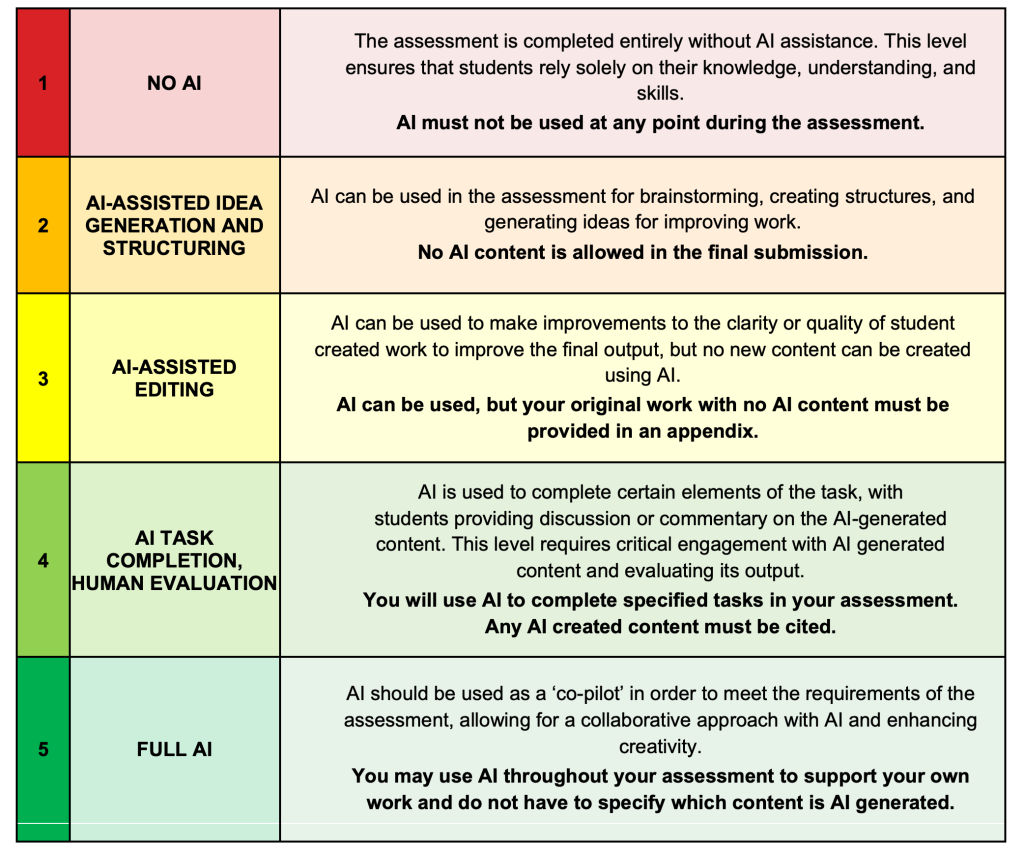
Level 1: No AI
At this level, students are not permitted to use GenAI in any form. This is appropriate for assessment tasks where it is preferable or necessary for students to rely solely on their own understanding, knowledge, or skills or where the use of GenAI is impractical or impossible. Although this stage may include the provision of technology-free examinations, it does not necessarily require examination conditions. For example:
- Technology-free discussions, debates, or other oral forms of assessment.
- Technology-free ideation, individual, or group work in class.
- Ad-hoc or planned viva-voce examinations, question and answer sessions, or formative discussions between students and educators.
We recommend that any Level 1 activities be conducted under supervision or for low-stakes, formative assessments. This is due to potential equity concerns with permitting out-of-class work under “no AI” conditions.
Level 2: AI assisted idea generation and structuring
At this scale level, students are permitted to use GenAI for brainstorming, gaining feedback, and structuring ideas; however, the final submission should not contain any content that was directly generated by AI. This level is useful for tasks in which students may benefit from extra support in developing ideas or improving their work, but in which the final product must be solely human-authored. Using GenAI tools at this level may benefit students by allowing them to explore a wider range of ideas and improve the depth or final quality of their work. Examples of Level 2 activities include:
- Collaborative brainstorming: Students can use AI to generate ideas or solutions to problems. These ideas can then be discussed, filtered, and refined by students in a collaborative setting.
- Structural outlines: Students may use AI to create structured outlines of their work.
- Research assistance: AI may be used to suggest topics, areas of interest, or sources (using an Internet-connected model) that might be useful for a student’s research.
Level 3: AI assisted editing
At Level 3, students are permitted to employ generative AI for refining, editing, and enhancing the language or content of their original work. This may be particularly beneficial for non-native English speakers or those who struggle with language fluency. In a multimodal approach to assessment, GenAI tools might be permitted to support the editing of images or videos, but not for creating entirely new pieces. Examples include:
- Grammar, punctuation, and spelling: Students may use AI to identify and rectify grammatical, punctuation, spelling, and syntactical errors in their work.
- Word choice: AI can suggest appropriate or synonymous terms to replace simpler words and phrases, helping clarify writing.
- Structural edits: For students who may struggle to construct clear and coherent sentences, AI can assist in rephrasing for clarity without altering the original meaning.
- Visual editing: Image generation tools may be used to edit original images, such as through techniques like generative fill and generative expand (also referred to as in-painting and out-painting).
At this level, students are expected to submit their original work for comparison alongside AI-assisted content, thus ensuring the authenticity of their contributions. Assigning a Level 3 AI scale can make a traditional assessment task suitable for use in an AI-inclusive assessment environment, but it is more of a stop-gap approach which can be used until assessment tasks can be more fully adjusted to align with GenAI tool usage.
Level 4: AI Task Completion, Human Evaluation
At this level, students are requested or expected to use GenAI to complete specific portions of their tasks, but the emphasis remains on human evaluation and interpretation of the AI-generated content. Students must critically engage with and assess the AI outputs that they have created and evaluate their relevance, accuracy, and appropriateness. This level encourages a deeper understanding of the capabilities and limitations of GenAI tools, beyond basic text generation or editing. For example:
- Direct AI generation: Students may be tasked with using GenAI to produce content on a specific topic, theme, or prompt. This could range from generating datasets, social media posts, or crafting narratives. Students would use this as a basis for an original piece of work in which they may submit both the generated work and their own.
- Comparative analysis: After AI produces content, students may be asked to compare it with human-created content on the same topic, identifying differences, similarities, and areas of divergence. This can include comparisons with human-generated content.
- Critical evaluation: Students generate content with the express purpose of critiquing the output and questioning its choices, biases, and potential inaccuracies.
- Integration: Students may be tasked with integrating AI-generated content into a larger project to ensure cohesion and alignment with broader objectives. This might constitute part of an industry project or part of an authentic assessment task.
Level 4 introduces a more complex interplay between AI and student inputs. Here, students are expected to engage critically with AI outputs. This level is not prescriptive about the sequence in which AI and human intelligence interact; it allows for the possibility that students may or may not be allowed to use GenAI to aid in the rewriting process after conducting their analysis, but any GenAI content must be cited appropriately for transparency. This flexibility is intentional, acknowledging that the creative and iterative processes of academic work often do not follow a linear pathway. For example, they may conduct their own analysis and then refine or rework the output using GenAI tools. Deeper engagement with and evaluation of any GenAI-created content is an important element that defines Level 4 of the AIAS.
Level 5: Full AI
At the final level, AI may be used throughout the task at the student’s discretion or instructor’s suggestion. Assessments at this level may specify or recommend GenAI tools to be used or may allow students’ discretion in their choice. Level 5 might be used in tasks which require the use of GenAI tools as part of addressing learning outcomes or when the skills and knowledge being assessed can be tested irrespective of AI usage. This level is also designed to allow for the exploration of GenAI as a collaborative and creative tool and reflects ways in which these technologies are being used outside of education, in fields such as journalism and marketing, where AI-generated content is increasingly used but still requires human editorial oversight (Hartmann et al., 2023; Kshetri et al., 2023). Example tasks include:
- Co-creation: Students are given broad themes or parameters in which they may achieve a task, and then actively iterate on GenAI content using a range of different tools and modes.
- GenAI exploration: Students use various GenAI tools to explore a wide range of ideas, styles, or solutions, exploring the ethical and practical implications of technology in a given domain.
- Real-time feedback loop: As students work on a task, they can continuously use GenAI to adjust their work, thereby shaping the final output.
- GenAI products: Students create finished products or artefacts using GenAI throughout, such as completed software or entire artworks.
References
Dawson, P. (2020). Defending Assessment Security in a Digital World: Preventing E-Cheating and Supporting Academic Integrity in Higher Education. Routledge. https://www.routledge.com/Defending-Assessment-Security-in-a-Digital-World-Preventing-E-Cheating/Dawson/p/book/9780367341527
Hartmann, J., Exner, Y., & Domdey, S. (2023). The power of generative marketing: Can generative AI reach human-level visual marketing content? (SSRN Scholarly Paper 4597899). https://doi.org/10.2139/ssrn.4597899
Kshetri, N., Dwivedi, Y. K., Davenport, T. H., & Panteli, N. (2023). Generative artificial intelligence in marketing: Applications, opportunities, challenges, and research agenda. International Journal of Information Management, 102716. https://doi.org/10.1016/j.ijinfomgt.2023.102716
Risko, E. F., & Gilbert, S. J. (2016). Cognitive Offloading. Trends in Cognitive Sciences, 20(9), 676–688. https://doi.org/10.1016/j.tics.2016.07.002
Citation
Perkins, M., Furze, L., Roe, J., & MacVaugh, J. (2024). The Artificial Intelligence Assessment Scale (AIAS): A framework for ethical integration of generative AI in educational assessment. Journal of University Teaching and Learning Practice, 21(06). https://doi.org/10.53761/q3azde36

VSCS Libraries
Library Learning Modules in Canvas
This past spring we released 11 new Library Learning Modules (LLMs) on information literacy for Canvas courses! These modules were designed with accessibility, long-term durability, Canvas compatibility, and academic standards in mind. Attend our LLM Informational Workshop on Monday, October 12 at 1pm.
Banned Books Week
The VSCS Libraries and The Office of Culture and Institutional Excellence are partnering to create library displays for Banned Books Week! We would love to get your input on your favorite banned book. If you have any questions, feel free to reach out to libraries@vsc.edu.
Banned Books Week Participation Survey
2026 Midterms Election Topic Guide
Check out our 2026 Midterm Election Guide! This guide will help you find key dates and resources to stay informed about the 2026 elections.
Need Help?
Contact the VSCS Libraries. Let us know how we can help!
Academic Support
Study Hall – Lyndon Campus
The Lyndon campus is now offering study hall hours Mondays – Thursdays from 7:00 pm – 9:00 pm. This is a result of a partnership between Academic Support and Athletics, but all students are welcome. Sessions are hosted in Academic Support, LAC 325, and managed by one to two student proctors and tutors. We hope to offer daytime sessions in the future.
Disability Services
Disability Services would like to wish all faculty members a happy Fall Semester and to share the following updates with you.
New Team Member
Michelle Bachand is the newest member of the Disability Services team. Michelle is located at the Lyndon Campus and works with students from the Lyndon Campus, Nursing sites, and the Castleton Campus.
Connecting with Us
Please remember that you can always reach out to the DisabilityServices@VermontState.edu email if you are not sure who the best person is to connect with about your questions or to refer a student to. Students can also be referred to the Disability Services Student Portal tile to request new or updated accommodations.
Staying in the Loop Presentation
Our team would like to invite you to join us on Monday, October 26th for the CTLI Staying in the Loop series to learn what is happening in our department and ask any questions that you may have. The session is being held from 12:15p-1:00p and you can sign up to attend on the CTLI Events page.
Academic Affairs – Radiologic Science
New Program Director
Kimberly Leonard, Kim (as she likes to be called) was an adjunct instructor with Vermont State University radiography before being selected for the Program Director role. Her radiography background is primarily in diagnostic radiology with a focus on leadership and urgent care.
Kim was trained in x-ray by the U.S. military’s medical program and has her master’s in healthcare administration (MHA) from Champlain College here in Vermont. She has spent time as an item writer and on an exam committee for American Registry of Radiologic Technologists (ARRT). Most recently she spent the last three years teaching leadership for the Army. Anecdotally, she has a love of dogs as well as an assortment of other critters, and as she puts it, a real risk of marrying a veterinary technician.
The Rural Opportunity and Development (ROAD) to Success Program
The Rural Opportunity and Development (ROAD) to Success program at Vermont State University is a federally funded program that supports Vermont’s rural population, providing comprehensive support to rural Vermont high school graduates (see Vermont State’s Road to Success webpage for exceptions and information) and/or transfer students from rural CCV academic centers enrolled at VTSU. ROAD to Success supports flexible career pathways, success advising, 24/7 remote tutoring, and experiential learning. Our project also helps remove some of the barriers faced by our rural Vermont undergraduate students, by determining the needs for technology, such as the use of a laptop or iPad, or helping to strengthen someone’s internet connection, by funding unpaid internships or research experiences, and more.
If you are teaching and/or advising an undergraduate student who has graduated from a rural Vermont high school or a rural campus of Community College of Vermont and attending one of our VTSU campuses (Johnson, Lyndon, Castleton, Randolph, Online while living in rural Vermont, or commuting to Williston from a rural Vermont home) they may qualify for acceptance into the ROAD to Success Program. This may give them access to a loaner laptop or iPad, funding for an unpaid internship (or student teaching), and other resources that will support their undergraduate studies at VTSU.
Please ask them to fill out the application today!
The VSC IT Learning Technologies Team
For support with your instructional and classroom technology needs, please visit the VSC Learning Technologies SharePoint site.
Review the Learning Spaces section of the site to connect with VSC classroom technology staff, troubleshoot and report technical issues, and find equipment overviews, detailed technical guides, responses to frequently asked questions, classroom maintenance schedules, information about upcoming enhancements, and the types of support available across our campuses.
Access the Academic Applications section of the site for timely content and resources for Canvas, Zoom, Lumina (YuJa), Panorama, ReadSpeaker, Respondus, and other VSC educational tools. Site visitors that need additional 1:1 assistance can learn how to connect with team members, including Senior Instructional Technology Specialist Sean Dailey who hosts drop-in Zoom sessions throughout the year.
Sharing Canvas Content
VSC faculty have long enjoyed the ability to share their Canvas materials with colleagues through Canvas Commons (click to access instructions and tutorial video). Instructors can also request copies of their courses be made available to colleagues via Canvas Sandboxes. Providing access to entire Canvas courses through a Canvas Sandbox is a safe way to provide access to a Canvas course while protecting student data and avoiding potential issues with FERPA. Please submit a ServiceDesk ticket to get started.
For help from the VSC IT Learning Technologies Team, please submit a ServiceDesk ticket.
Career Development
Fall Workshop Series
VTSU students have the opportunity to explore career readiness through interactive virtual workshops on resumes, internships, job searching, interviewing, Handshake, and more.
- Job Search (October 14, 12:15-1:15pm)
- Internship (October 28, 12:15-1:15pm & 6:00-7:00pm)
- Interview (November 11, 12:15-1:15pm)
Please encourage your students to join us for one or more sessions!