Note: This page is best viewed on a larger screen; it may be difficult to read on a mobile device or tablet.

All About Signature Assignments
Use the lefthand tabs or the next/previous links at the bottom of each page to navigate through a self-paced tutorial by the VTSU Center for Teaching & Learning Innovation focused on identifying and effectively using signature assignments tied to program learning outcomes.
The content in this tutorial is adapted from the original content licensed by the Core Curriculum Committee in the CSU Core Curriculum Handbook under a Creative Commons Attribution-NonCommercial-ShareAlike 4.0 International License by the Center for Teaching & Learning Innovation (CTLI, Vermont State University). Changes include generalizing language away from authentic assessments only, shifting to Learning Outcomes vs Core Curriculum, and emphasizing shared rubrics.

The Continuous Improvement Cycle
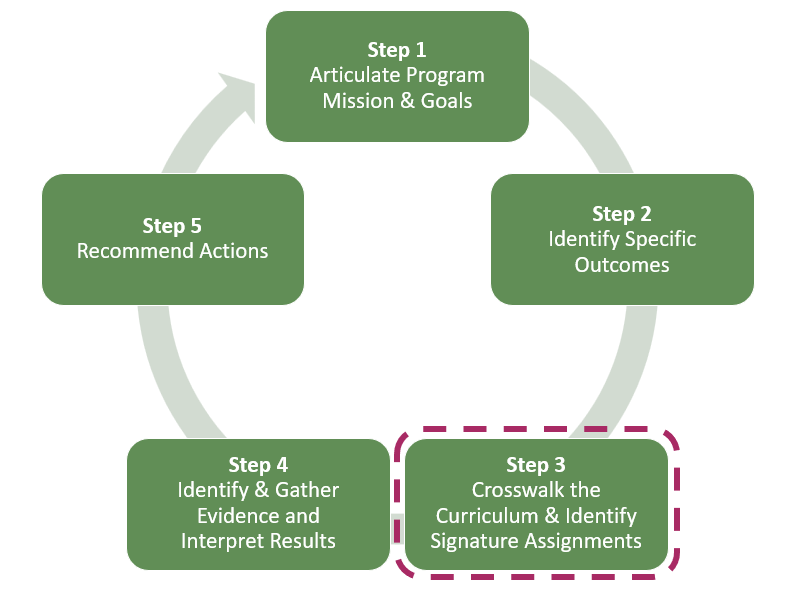
We engage in program assessment for continuous improvement. The use of signature assignments provides an intentional way to collect direct evidence of student learning through classroom assessments, during Step 3 of the continuous improvement cycle.
What Are Signature Assignments (SAs)?
As part of the VTSU assessment process, programs develop a Curriculum and Learning Outcomes Crosswalk, in which they identify whether a requirement provides an introductory, applied, or mastery learning experience toward one or more Program Learning Outcomes (PLOs).
A signature assignment directly assesses students’ learning toward one or more PLOs – essential program-level skills/knowledge – against that level of articulated learning (introductory, applied, mastery).
Signature assignments are course-level assignments mapped to one or more Program Learning Outcome(s) and one or more Course Learning Outcomes.
They take many formats, depending on disciplinary context.
They include a reflective element.
Typically, there is only one signature assignment per course.
There is no single form a signature assignment takes – exams, projects, papers, presentations, etc. all have the potential to assess students’ demonstration of their learning toward PLOs.
Signature assignments also include a reflective component, giving insight into students’ process and/or perception of their learning. This is a way to combine direct and indirect evidence collection for program assessment.
Some programs develop signature assignment prompts that can be adapted by any faculty teaching a particular course (when there are multiple sections of a single course). Although these “common” signature assignments are not a VTSU requirement, the practice can make it easier to aggregate results across sections and identify gaps in the curriculum. When developing common signature assignments, be sure to include these elements:
- Task and purpose
- Program learning outcomes addressed
- Directions for students with formatting and content requirements
- A rubric
How Are SAs Used for Program Assessment?
Signature assignments (whether identical or distinct across sections) do share a common rubric that addresses the Program Learning Outcomes, at the appropriate level of learning for the course.
For example, if one section of the Intro to the Major course has students doing a presentation and another section of that same Intro to the Major course has students writing a paper, the SAs will be assessing the same expected learning, even though the format of those assignments differs. The instructors for those two sections may have additional rubric items specific to the course, but the shared items focus on the identified Program Learning Outcomes. These shared rubrics allow the program to aggregate student learning across sections, assessing the curriculum (not instructors or courses). These rubrics are used to collect direct evidence for program assessment.
While ePortfolios are not essential to using SAs, it is not uncommon for institutions to have students collate evidence in a single location to evaluate learning over a progression of coursework.
Why Is Reflection Included in SAs?
The reflective component provides programs with a source of indirect evidence, providing context and insight into the direct evidence collected on those same SAs through a shared rubric.
Reflection makes thinking visible, by prompting students to draw connections between the Signature Assignment and the Program Learning Outcome(s).
It is important that the reflection activity is structured and meaningful to students.
It should also be assessed along with the product, providing indirect evidence for program assessment. The reflection is equally important for student learning when done intentionally, as students are prompted to engage in metacognitive thinking.
Here are just a few examples of ways to include reflection in a SA:
- Have students write a cover letter to their work describing their process for completing the assignment.
- Have students write a one-page reflection related to connections between concepts within the signature activity, across the class, across their major, across their degree as a whole, with their community, and/or within themselves as they grow and change (choose what level(s) of connection you want students to reflect on).
- Have students assess their work against the rubric, noting strengths and areas of concern or insecurity.
- Have students write three paragraphs using the What, So What, Now What framework:
- What did you learn?
- Why was the learning important?
- What does this learning mean for you, going forward?
- Have students identify:
- 3 things they learned doing the assignment
- 2 new connections they made
- 1 step they’d like to do next to extend their learning
Can SAs Be Included in Gen Ed Courses?
SAs are a great way to address the Gen Ed PLOs as well as any PLOs for the major, weaving together disciplinary knowledge and skills/knowledge relevant to the Gen Ed.
As a reminder, these are the VTSU Gen Ed PLOs (May 2024), which also align with the VSC Core Competencies for graduation:
- Communication: Students will create and deliver written, oral, and/or visual communication that is purposeful, organized, engaging, and adheres to academic standards of clarity, development, and presentation.
- Critical Thinking: Students will utilize different perspectives and methods of diverse disciplines to analyze and effectively address problems in those disciplines and in the world.
- Equity: Students will identify, describe, and/or analyze systems of inequity and/or just responses to them.
- Technology: Students will apply digital tools and computing technologies to analyze problems, manage information, enhance productivity, and communicate effectively, while using technology responsibly and ethically.
- Integration: Students will reflect upon and assess their learning throughout the general education program, considering how it can be integrated with learning in their major program, co-curricular activities, and/or their lives.
As mentioned previously, signature assignments can take many forms and can be implemented across the disciplines.
Here are some ideas for signature assignments for any course, including in the gen ed:
- Essays, response papers, lab reports or research papers tap disciplinary knowledge and effective communication, as well as potentially critical thinking, technology, and equity.
- Solution to a realistic math problem where students write about the process, relevance, and application of the problem-solving skill to other issues, demonstrating critical thinking.
- Photos, graphics, or three-dimensional artwork can address disciplinary knowledge, communication, and the creative aspects of critical thinking.
- Powerpoints, spreadsheets, databases, and webpages can all be used to address communication, critical thinking, technology, equity, and integration outcomes.
- Poetry, fiction, pamphlets, posters, and other forms of writing address disciplinary knowledge, communication, and the creative aspects of critical thinking.
- Products of group projects can be excellent signature assignments, allowing students to demonstrate disciplinary knowledge, communication, critical thinking, integration.
What Might You Consider When Identifying/Developing a SA?
Whether an SA is being developed by the instructor or the program, these guiding questions may be helpful in ensuring that the SA serves the purpose of assessing the outcome at the intended level.
- What do you, or professionals in the field, do that students should be able to do upon successful completion of the course?
- What is the most important level of learning in your course? Or the most important thing for students to be able to do upon completion of your course?
- What sort of thing could students do upon successful completion of your course that would show them the value of what they learned?
- What sort of reflection or self-assessment can students do, related to the signature assignment, to deepen their learning?
How Should SAs Be Graded?
SAs should be factored into the overall grade and/or completion of the course – in other words – faculty should signal to students that they are important by putting some weight on them.
SAs don’t have to be the most points or most weighted of all assignments, however, within the course.
All grading decisions are left open to the instructor. Any grading methodology (e.g., points, percentages, specifications, etc.) can be used with signature assignments, allowing ease-of-integration with the assessment structure of any individual course.
Program Assessment Support
Is there support available?
Yes, there is support available for the program assessment process.
Consulting with a group of faculty colleagues is a great place to start and one recommendation is to schedule a formal meeting, series of meetings, and/or departmental retreat to address program assessment.
In addition to faculty colleagues, there are campus partners who are available to provide additional support and program assessment leads are encouraged to:
- Consult with the Center for Teaching & Learning Innovation
- Access institutional data on the Institutional Analytics SharePoint site
- Contact Institutional Research with additional data-related questions and requests
References
You may find it useful to browse these sources that were used in the development of this presentation.
CSU Core Curriculum Committee. (n.d.). Signature Assignments. Retrieved May 21, 2024, from https://pressbooks.ulib.csuohio.edu/corecurriculum/chapter/signature-assignments/
Pinahs-Schultz, P., & Beck, B. (2016). Development and Assessment of Signature Assignments to Increase Student Engagement in Undergraduate Public Health. Pedagogy in Health Promotion, 2(3), 206–213. https://doi.org/10.1177/2373379915606454
Quinlan, K. M., & Pitt, E. (2021). Towards signature assessment and feedback practices: A taxonomy of discipline-specific elements of assessment for learning. Assessment in Education: Principles, Policy & Practice, 28(2), 191–207. https://doi.org/10.1080/0969594X.2021.1930447
Roach, S., & Alvey, J. (2021, February 4). Fostering integrative learning and reflection through “signature assignments.” AAC&U. https://www.aacu.org/liberaleducation/articles/fostering-integrative-learning-and-reflection-through-signature-assignments