Note: This page is best viewed on a larger screen; it may be difficult to read on a mobile device or tablet.
How to Complete and Use the Curriculum and Learning Outcomes Crosswalk
Use the lefthand tabs or the next/previous links at the bottom of each page to navigate through a self-paced tutorial by the VTSU Center for Teaching & Learning Innovation focused on developing the curriculum and learning outcomes crosswalk for the purpose of identifying students’ learning progression through the degree program and key course-level signature assignments.
The Continuous Improvement Cycle
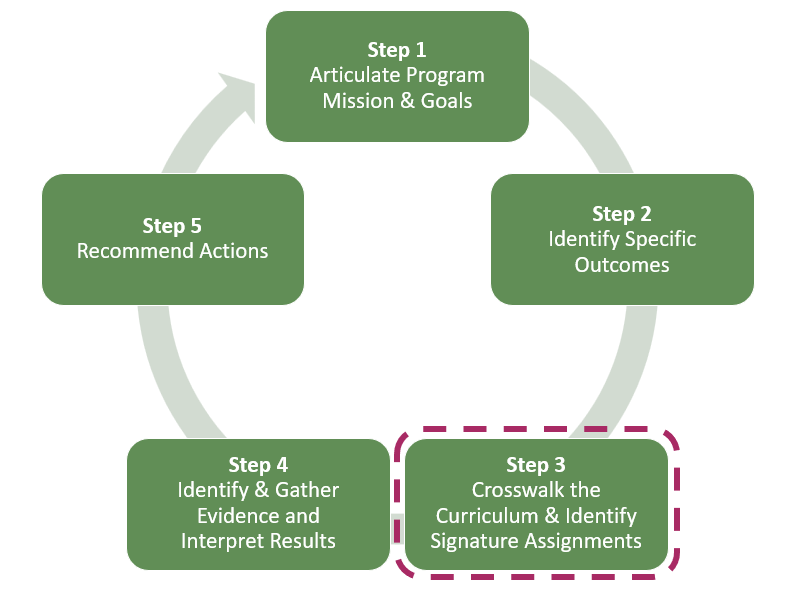
We engage in program assessment for continuous improvement. The Curriculum and Learning Outcomes Crosswalk allows faculty members to easily understand at what points in the program knowledge, skills, and values are going to be addressed.
The Crosswalk
What is the Curriculum and Learning Outcomes Crosswalk?
A program assessment document, depicting the alignment between the program’s curriculum and its student learning outcomes.
How is it Organized?
The crosswalk is organized in a table format that:
- Lists student learning outcomes on the vertical axis
- Lists the courses in the program on the horizontal axis
- Establishes whether a learning outcome is being introduced (I), applied (A), or mastered (M).
Once developed, it allows faculty members to easily understand at what points in the program knowledge, skills, and values are going to be addressed. As it is impacted by all of the courses in a given program, there are advantages in assessing it as a group in a meeting or series of meetings.
Benefits of the Crosswalk
What are the benefits of developing the Curriculum and Learning Outcomes Crosswalk?
- It is an excellent planning tool when the curriculum is initially developed and for new faculty to understand the role of their course(s).
- It is used to visualize and understand how course-level outcomes align with program-level outcomes.
- It is used to evaluate the current alignment between existing curriculum and student learning outcomes.
What key questions should be considered?
In terms of evaluation, examples of questions faculty members should discuss and reflect upon include:
- Are all outcomes aligned with courses?
- Are all outcomes addressed in a logical order?
- Are all outcomes first introduced and then applied (reinforced) and then measured for mastery?
- Are there redundancies, overlaps, and gaps in the curriculum?
Importance of Curricular Alignment
Establishing and maintaining curricular alignment in a program is an important part of assessment and programs should strive to do the following:
- Align program-level student learning outcomes with the program’s mission and goals.
- Align course-level objectives with program-level student learning outcomes.
- Align summative assessments with the course-level objectives.
Part I: Sample
The first part of the Curriculum and Learning Outcomes Crosswalk document depicts the alignment of the curriculum with the program learning outcomes as shown in the sample below.
In addition to individual courses, seminars, field experience, and capstones should be factored into the crosswalk. Also, it is worth noting that classes offered early in the program will likely have student learning expectations that are at an introductory level whereas courses offered later in the program will have expectations that involve application and mastery.
Part I: Sample
|
Program Outcome 1 |
Program Outcome 2 |
Program Outcome 3 |
Program Outcome 4 |
|
|---|---|---|---|---|
|
Program Required: Course 1 |
Introductory (I) |
Introductory (I) |
Introductory (I) |
|
|
Program Required: Course 2 |
Applied (A) |
Introductory (I) |
||
|
Program Required: Field Experience |
Applied (A) |
Applied (A) |
Applied (A) |
|
|
Program Required: Elective Course Options / Categories |
Mastery (M) |
|||
|
Program Required: Capstone Seminar |
Mastery (M) |
Mastery (M) |
Mastery (M) |
Part II: Sample
The second part of the Curriculum and Learning Outcomes Crosswalk document demonstrates the alignment of summative assessments to the course-level learning objectives that are tied to the program outcomes.
Developing this more granular section of the document creates an opportunity to engage multiple faculty members in conversations about whether their summative assessments are actually targeting the course-level objectives that are tied to the program outcomes. Also, it provides faculty teaching separate sections of the same course an opportunity to discuss what students must do to meet the stated course-level objectives; some programs or departments may choose to adopt common summative assessments across sections while others will allow latitude for faculty to develop well-aligned summative assessments.
Part II: Sample
|
Course-level learning objective(s) relevant to program outcomes |
Aligned summative assessments |
|
|---|---|---|
|
Program Required: Course 1 |
|
|
|
Program Required: Course 2 |
|
|
|
Program Required: Elective Course Options / Categories |
|
Submission Deadline
When is the Curriculum & Learning Outcomes Crosswalk Submitted?
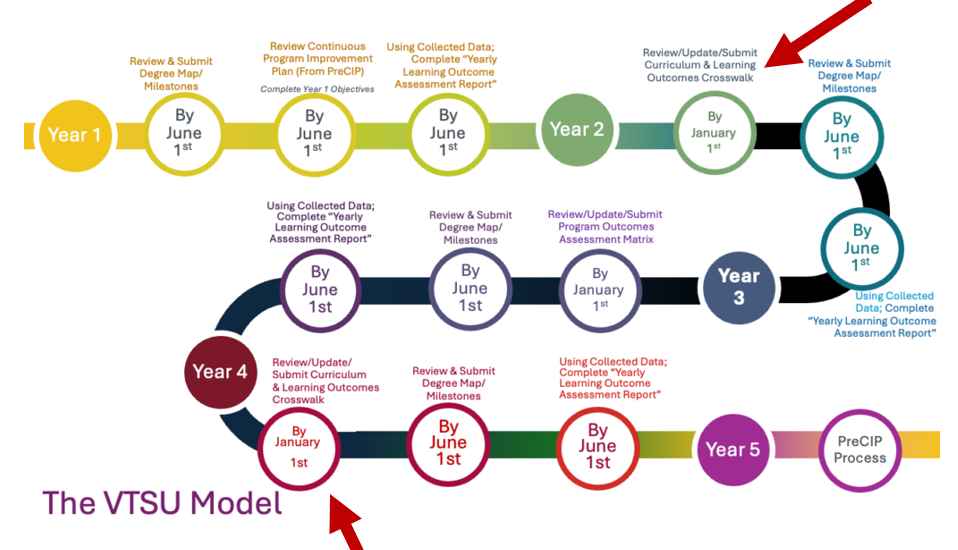
The crosswalk is due by January 1st of the second year of the continuous improvement cycle with an updated version being due by January 1st of the fourth year of the cycle as shown in the VTSU Program Assessment Model.
The Curriculum and Learning Outcomes Crosswalk Template
Is the use of a template a requirement?
Yes, and a Word-based copy of the report template is available on the VTSU Program Assessment SharePoint site.
Once you’ve accessed the site, scroll to the Important Links section and select the Assessment Docs – Templates button. Then, download a copy to get started.
Examples of Completed Reports
Are there examples of previously submitted crosswalks?
Yes, PDF-based exemplars from prior years are on the VTSU Program Assessment SharePoint site.
Once you’ve accessed the site, scroll to the Important Links section and select the Assessment Docs – Examples button. Then, review examples previously submitted by your faculty colleagues.
Submitting the Report
How is the Yearly Learning Outcomes Assessment Report submitted?
Navigate to the VTSU Program Assessment SharePoint site and scroll to the Program Assessment Documents section. Then, select the Submit Required Documents button.
The resulting form is used to attach the completed PDF document, and the submission will automatically be forwarded to the applicable program coordinator or dean to review. The report submission is part of a structured workflow. Do not submit the file(s) by email or any other means.
Program Assessment Support
Is there support available?
Yes, there is support available for the program assessment process.
Consulting with a group of faculty colleagues is a great place to start and one recommendation is to schedule a formal meeting, series of meetings, and/or departmental retreat to address program assessment.
In addition to faculty colleagues, there are campus partners who are available to provide additional support and program assessment leads are encouraged to:
- Consult with the Center for Teaching & Learning Innovation
- Access institutional data on the Institutional Analytics SharePoint site
- Contact Institutional Research with additional data-related questions and requests