February 2026 | Volume 3 | Issue 7 | Previous Issues
Each month, this year, we’re highlighting at least one teaching tip from one domain of the Teaching Effectiveness Framework (TEF). Our teaching tips for this month come from the Curriculum/Curricular Alignment domain. The approaches in this domain provide the foundation for any course. Instructors who connect course learning objectives, assignments, activities, and assessments provide students with a clear path to success in their course.
Use a Course Workload Estimator
The button below will launch a course workload estimator, which can be used by members of the faculty to determine the anticipated time commitment for students participating in a given class.
Please keep in mind that the most quantifiable approach to course planning, as outlined by the U.S. Department of Education, reasonably approximates to not less than one hour of class and two hours of out-of-class student work per week over the course of a standard 15-week semester. In the case of a 3-credit course, for example, the required time commitment equates to a minimum of 45 hours of instructor-led academic engagement and 90 hours of independent student academic preparation. This guideline has also been adopted by NECHE, Vermont State University’s accreditation body. The VTSU Undergraduate Credit Hours & Faculty-Student Engagement Policy provides additional information and examples of the hours required for academic engagement and academic preparation.
The course workload estimator can be used to calculate the number of hours may reasonable spend completing academic work: reading, writing, viewing videos and podcasts, engaging with discussion posts, taking exams, completing assignments, and participating in class meetings. It can be easy for a university instructor to under-estimate the time it takes for students to complete a task. Additionally, some faculty may be too cautious about assigning students an unreasonable workload and inadvertently set expectations too low for students. Using a workload estimator can assist with creating an appropriately challenging yet reasonable student experience.

Phil Whitman
This month, we have the pleasure of featuring Phil Whitman, an Associate Professor of Art at VTSU who teaches on the Castleton campus in the Arts, Humanities, and Communication department.
Please tell us a little bit about your background and what brought you to VTSU.
I grew up in upstate New York, with interests in sports, history, and art. I earned a graduate degree in Painting from the Rhode Island School of Design, and worked in a number of galleries and museums around the country. Around 2010, I moved from New York City to Vermont, and sent letters of inquiry to all the art programs in the state. The only person who responded was Professor Jon Scott at Castleton State College, who invited me to teach an Intro to Art History course as an adjunct instructor. I’ve been teaching in the Fine Arts program at the Castleton campus ever since.
What advice or tips do you have for faculty members who recently joined our university?
I would recommend that new faculty try to get involved with any of the committees, working groups, task forces, etc. within the University. When I first became a full-time faculty member, Professor Emeritus Bill Ramage actually gave me the exact opposite advice- telling me NOT to get involved with committee work, as it would become all-consuming. He wasn’t wrong(!)- but I’ve found really valuable connections to faculty in other programs and on other campuses through serving on various University-wide groups. I came to better understand and appreciate the power we have to shape the educational experience of all our students.
What do you enjoy about teaching in the Gen Ed program?
Almost every Studio Art and Art History course I teach is part of the Connections Gen Ed program. So, while I may have some Art majors in my classes, I always have non-majors as well. This helps me to try to frame everything we do in terms of each student’s holistic experience. I like that I can help impact students in all sorts of programs.
What important lessons have you learned from VTSU students that have shaped you as a teacher?
I think that coming through the Covid pandemic years, and the subsequent transformation of the University, our students have helped me to realize that they each have individual strengths, as well as very real challenges that they are facing. I think I’ve become more flexible as an instructor, and more willing to help students find different ways to connect what we’re learning to their own lived experience.
A theme in this month’s newsletter is curricular alignment. When developing or re-developing a course, what are steps you take to be sure your assignments and activities align with your course learning objectives?
With the transformation and ‘optimization’ of the University, it sometimes feels like we’re constantly developing or re-developing courses. The upside of this is the chance to more consciously consider how and where students are learning and developing certain skills throughout the overall degree program. This trickles down to the course level. In a painting project, for example, students are constantly making small decisions and developing specific skills throughout the process. However, I’ve found that by asking students to actively reflect on this learning, especially through writing, they can better articulate to themselves HOW all those discrete, minute decisions have added up to the Learning Objectives for the course. I think this reflective writing helps make the achievement of the Learning Objectives more evident and tangible for students.

Presentation from the 2025-26 AI Faculty Learning Community
Register Now: Best Practices and Lessons Learned
A faculty learning community (FLC) is a small interdisciplinary peer-led group who engages in a collaborative program focused on building a sense of community and enhancing teaching and learning. During the 2025-2026 academic year, the CTLI-sponsored FLC focused on generative AI, and the members have developed a series of recommendations and best practices to share with their faculty peers.
- Format: Presentation followed by a participant panel
- Date: Wednesday, May 6th, from 3:00-4:15p
Learn more about the event, which will be held on Zoom, and register for it at your earliest convenience.
The Center for Teaching & Learning Innovation
Digital Accessibility Skills Series with Jeff Tunney
This workshop series is geared toward faculty and staff members with a basic knowledge of sound digital accessibility practices. The workshops will include hands-on activities that align with accessibility learning modules developed by the CTLI over the past several months and participants are encouraged to review the applicable modules prior to each scheduled session.
Registration
While you are welcome to attend all 6 sessions, we also invite faculty to come to some of the sessions based on interest in the topic or schedule availability. Register now for one or more sessions!
Workshops:
February 2: Creating Accessible Hyperlinks
February 16: Selecting Accessible Color Combinations
March 2: Structuring Accessible Documents
March 16: Writing Alt Text, Image Descriptions, and Captions
March 30: Exploring Alternatives to PDFs
April 13: Developing Accessible Emails
The VSC IT Learning Technologies Team
Panorama Playground Series with Sarah Chambers
Panorama Playgrounds are interactive, hands-on workshops designed to help faculty improve the accessibility of their courses using YuJa Panorama.
Each session focuses on a specific type of content—Canvas pages, Word documents, PDFs, and Math formulas. Practicing skills using your own course is recommended. Questions are encouraged.
Registration
Register online to attend the entire Panorama Playground Series or one or more of the individual workshops below.
Workshops:
Wednesday, February 18 – 2:00-3:00 PM
- What is Panorama??
- Understanding your Panorama score
- Understanding your Panorama accessibility score
Wednesday, February 25 – 1:00- 2:00 PM
- Panorama and the Canvas Rich Text Editor
- Remediating text inside of Canvas (assignments, pages, quizzes, etc.)
Tuesday, March 3 – 11:00 AM – 12:00 PM
- Panorama and the Canvas Rich Text Editor
- Remediating text inside of Canvas (assignments, pages, quizzes, etc.)
Friday, March 6 – 11:00 AM – 12:00 PM
- Panorama and Word/PowerPoint/Excel
- Remediating Microsoft Office 365 documents with Panorama
Wednesday, March 11 – 1:00 – 2:00 PM
- Panorama and Word/PowerPoint/Excel
- Remediating Microsoft Office 365 documents with Panorama
Monday, March 16 – 1:00 – 2:00 PM
- Math formulas
- Options for creating accessible math formulas
Friday, March 20 – 11:00AM – 12:00 PM
- Math Formulas
- Options for creating accessible math formulas
Monday, March 30 – 1:00 – 2:00 PM
- PDFs and Accessibility
- Options for remediating PDFs
Tuesday, March 31 – 11:00 AM – 12:00 PM
- PDFs and Accessibility
- Options for remediating PDFs
Building Anti-Racist Educators: Reading & Inquiry Series
This Reading and Inquiry Series provides a monthly set of tools for learning, introspection and having conversations about issues of racism in our university, classrooms and communities. We hope that through regular reflection and conversation, you can get better at recognizing and resisting your biases and the impact they have on your students and colleagues.
Meetings:
The group will be meeting via Zoom on the following dates:
- Thursday, February 19th (3:00-4:30p)
- Thursday, March 19th (3:00-4:30p)
- Thursday, April 16th (3:00-4:30p)
- Thursday, May 21st (3:00-4:30p)
How to Sign-up:
To receive a calendar invitation, Zoom link, and access to the group’s Canvas space, please fill out the Vermont State Colleges Building Anti-Racist Educators Sign-Up Form.

Spring Series on Writing & Generative AI
The CTLI and Castleton Writing Coordinator are collaborating to deliver a series of 5 professional development sessions for faculty in the Spring 2026 semester on the topic of generative AI and writing in the college classroom.
While you are welcome to attend all 5 sessions, we also invite faculty to come to some of the sessions based on interest in the topic or schedule availability. These Monday sessions (from 12pm-1pm EST) are open to people with all levels of experience with generative AI. Register for one or more!
- March 2, 2026 @ 12:00 pm – 1:00 pm
Supporting an AI-Mindful Writing Process for Students
- March 30, 2026 @ 12:00 pm – 1:00 pm
Navigating AI when Teaching Research & Information Literacy
- April 27, 2026 @ 12:00 pm – 1:00 pm
An Emphasis on Learning while Writing with AI: Transparency, Accountability, & Innovation - May 11, 2026 @ 12:00 pm – 1:00 pm
Reflecting in Community: Learning & Next Steps
Upcoming Workshops
- August 28 @ 12:15 pm – 12:45 pm
Overview of Student Motivation and the Teaching Effectiveness Certificate
- September 2 @ 12:15 pm – 12:45 pm
Overview of Student Motivation and the Teaching Effectiveness Certificate
- September 11 @ 2:30 pm – 3:00 pm
Overview of Student Motivation and the Teaching Effectiveness Certificate
- September 14 @ 12:15 pm – 1:00 pm
Staying in the Loop Series – Health & Wellness
- September 15 @ 12:00 pm – 1:00 pm
Authentic Assessment: Designing Assignments for Motivation and Learning
- September 18 @ 2:30 pm – 3:30 pm
Critical Thinking, Part 1: The Paul & Elder Framework
- September 21 @ 12:15 pm – 1:00 pm
Staying in the Loop Series – Academic Support & TRIO Student Support Services
- September 22 @ 12:00 pm – 1:00 pm
Motivating Online Students: Practical Strategies for a One-Hour Course Tune-Up
As you likely know, starting in April 2026, all public higher education institutions of our size must be compliant with new regulations for accessibility of digital content. The regulations are based on the WCAG 2.1 AA standards, which are written for a technical audience.
In the CTLI, through the EdPros workshops, reading, and research, we have been gaining knowledge of digital accessibility. And we are creating tutorials on some of these key skills for faculty, translating the technical standards for general users. We are collating digital accessibility resources on our webpage for easy access, as well.
Check out our seventh tutorial on Developing Accessible Emails. And see if you can ace the knowledge check at the end!
Previous Tutorials:
- Top 5 Best Practices for Creating Alt Text, Image Descriptions, and Captions
- Top 5 Best Practices for Structuring Accessible Documents
- Top 5 Best Practices for Creating Accessible Hyperlinks
- Top 5 Best Practices for Selecting Accessible Color Combinations
- Top PDF Alternatives
- Panorama Best Practices
If you have feedback on the tutorial or topics you’d like to see us cover in future months, let us know by emailing ctli@vtsu.edu. Thank you so much.
The VSC IT Learning Technologies Team
Panorama Playground with Sarah Chambers
We encourage all faculty to attend one or more Panorama Playgrounds to work on improving accessibility of their courses using YuJa Panorama. See more information and register in the “Professional Development” section of this newsletter.
Accommodation Software Update
ReadSpeaker is the text-to-speech solution in Canvas. It can be found in Canvas at the bottom left of your screen.
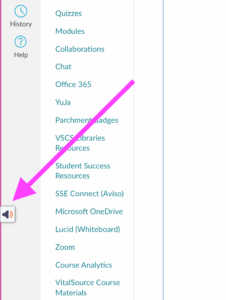
ReadSpeaker is also available for use in both Canvas Classic and New Quizzes. While updates to the ReadSpeaker webReader are coming in mid-to-late February, VSC students that require support in Canvas New Quizzes can access the ReadSpeaker Bookmarklet text-to-speech tool by pressing “control” and “R” simultaneously.
For help from the VSC IT Learning Technologies Team, please submit a ServiceDesk ticket.

VSCS Libraries
VSCS Libraries Usability Testing
We want you and your students to help us make our systems easier to use!
This semester, the libraries will be conducting usability testing on our online resources. This will consist of meeting (virtually) with students, faculty, and staff, asking them to complete tasks using the library systems, and then reflect on how it works for them.
Sign up on our Usability Interest Form, and please spread the word to your students. We want to reach as wide a range of our community as possible. All participants will be entered in a drawing for special prizes. Please contact Michael Braun Hamilton, our Web Services Librarian, at michael.braunhamilton@vsc.edu with any questions.
Vermont Reads Book Clubs: The Light Pirate
Vermont Reads is a statewide reading program run by the Vermont Humanities Council. The VHC selected The Light Pirate by CCV alum Lily Brooks-Dalton as this year’s reading book.
Get the Book
- Print Copies: Copies are available at every campus library! If you don’t live near a campus library, you can request to check out the book and have it sent to your home.
- Ebooks & Audiobooks: It is available through the Libby app as an eBook and audiobook for public library patrons whose libraries offer Libby, and on other platforms.
Join the Discussion
The VSCS Libraries will host book club discussion events on Microsoft Teams. These are informal, drop-in events open to all VTSU and CCV students, faculty, and staff.
Also look for Vermont Reads events around the state.
- Tue, Feb 3 | 7:00–8:00 PM
- Wed, Feb 4 | 12:00–1:00 PM
- Tue, Mar 3 | 7:00–8:00 PM
- Wed, Mar 4 | 12:00–1:00 PM
Disability Services
Greetings, from the Disability Services team. We would like to wish you a happy Spring semester and remind you that we are here to support you and your students with academic accommodations.
We know that the start of the semester is a time when students will be asking about academic accommodations, and we would like to remind you of our resources, all of which are available on the Disability Services tile on the VTSU Portal. Students and others can visit the Disability Services web page to learn about our services, schedule appointments, obtain contact information for our staff, and access all our forms and resources. Students who do not have current accommodations can disclose and request new accommodations using the First-Time Accommodation Request Form. Students who have been approved for accommodations can request an updated accommodation memo for the semester using the Accommodation Memo Request Form.
We have had some turnover on our team over the last two years, and we are happy to say that we currently have a full team of excellent Disability Services professionals at VTSU. Please reach out to any of us if you have questions or are in need of support, and feel free to refer students our way. You can also email DisabilityServices@VermontState.edu.
- Pam Billings, Johnson Campus and online students, pamela.billings@vermontstate.edu
- Autumn Piletz, Randolph and Williston campuses, app00335@vermontstate.edu
- Aimee Rozum, Lyndon Campus and Nursing Sites, aimee.rozum@vermontstate.edu
- Gerry Volpe, Castleton Campus, Gerry.Volpe@vermontstate.edu
We hope you have a great semester, and we look forward to working with you and your students.

The McNair Scholars Program
The McNair Scholars Program on the VTSU – Castleton campus is excited to welcome a new Associate Director, Kristin Eastman. The McNair Scholars Program provides paid research experiences and individualized graduate school mentoring and advising to first-generation, low-income, and underrepresented students on the Castleton campus.
Introduction from Kristin:
I am the new Associate Director of the McNair Scholars Program. After 13.5 school years as a school counselor, I am excited to transition to this role allowing me to use my prior training and skills to support McNair Scholars. I have always been passionate about providing support to students and I am committed to creating a safe and inclusive environment where every student can thrive. I am excited to bring my passion and experience to VTSU and I am eager to start working with all of you!
Outside of work, I enjoy spending time with my husband and two kids (ages 8 and 11 – both boys!) playing games, exploring the outdoors, traveling, gardening, cooking, woodworking, building with Legos, and attending concerts/musicals. I also play flute and piano (sometimes in concerts or shows but mainly for fun). In addition, I love to read about other people and different cultures, and I am always up to learning about or trying new things!
Please join us in welcoming Kristin Eastman to the McNair Scholars Program!
Debbie Warnock, PhD
Director, McNair Scholars Program
Student Success
The Office of Multilingual Student Sercices
Five Question Checklist for Course Success
Who are multilingual students?
Multilingual students are learners who use two or more languages in their lives and learning. At VTSU, they may include students who:
- Have varied immigration backgrounds, such as international students on an F1 visa who are temporarily in the United States, or students who are immigrants, naturalized citizens, refugees or asylum seekers, undocumented, or from mixed status families.
- Have widely different English learning histories, ranging from one year to many years of formal study, informal learning, or immersion experiences.
- May or may not submit standardized proof of English proficiency, especially some immigrant students who are not required to provide test scores if they completed more than three years of ESL support in US high schools.
Even when students appear fluent, multilingual learners can still have very different needs for linguistic and social scaffolding in your course. For example, some students write very well but speak less confidently because their prior English study emphasized grammar and writing. Others speak with ease after years of immersion, yet may lack formal academic literacy such as rhetoric, punctuation, and discipline specific writing conventions.
Five questions that help you personalize support and accommodations
- Which English skills are strongest for you? Please rank reading, writing, listening, and speaking from strongest to weakest.
Instructor reflection: How can I vary assessment options or evaluation criteria so the student can show content knowledge without being unfairly limited by current English level? - When you are thinking through complex ideas, which language comes first for you?
Instructor reflection: If the student’s strongest language is not English, can I allow translation tools, bilingual brainstorming, or a bit more time for processing? - In what class settings do you participate best: whole class discussion, small groups, one on one conversations, or written formats like discussion boards?
Instructor reflection: Can I offer multiple participation pathways and build in wait time, small group talk, or written alternatives for them? - What support helps you most when instructions feel hard: examples, visuals, step by step checklists, vocabulary lists, model assignments, or recorded directions?
Instructor reflection: Can I provide clearer task models, a brief glossary, chunked steps, and predictable weekly routines? - What is one course task that feels hardest right now, and what would make it easier: speed, vocabulary, reading volume, note taking, tests, group work, or understanding cultural references?
Instructor reflection: Can I reduce avoidable language load, clarify expectations, provide strategic extensions, or offer an earlier draft or low stakes practice?
Referral and long-term support
If you would like to refer a student for more support, please contact Academic Support ==> Multilingual Student Services (which can be found via portal) or Dr. Mary Dinh at Mary.Dinh@VermontState.edu. Faculty referrals can connect students to professional help, including one to one ESL tutoring, which provides sustainable, long-term benefits for academic success and future workplace communication.