Note: This page is best viewed on a larger screen; it may be difficult to read on a mobile device or tablet.

An Overview of the Yearly Learning Outcomes Assessment Report
Use the lefthand tabs or the next/previous links at the bottom of each page to navigate through a self-paced tutorial by the VTSU Center for Teaching & Learning Innovation focused on developing the yearly learning outcomes assessment report for the purpose of summarizing assessment activities and findings on an annual basis.
The Continuous Improvement Cycle
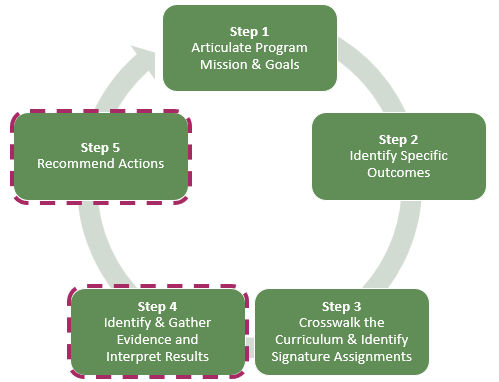
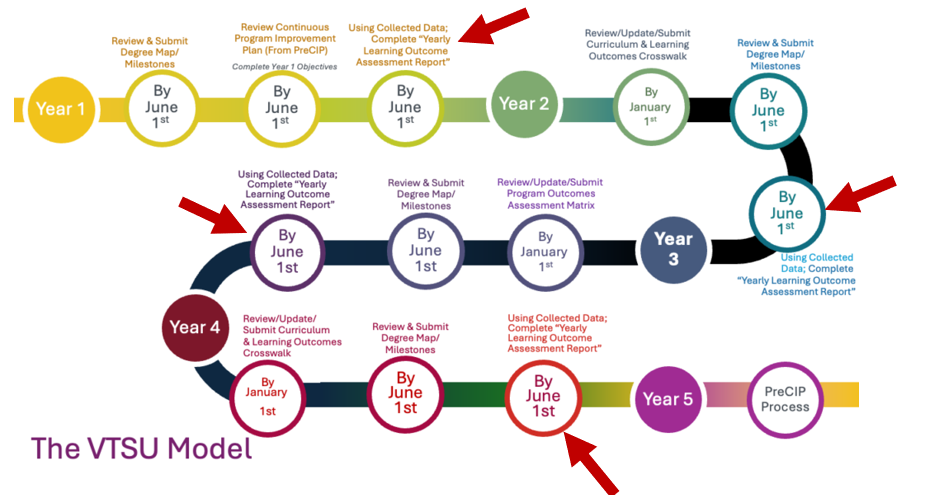
We engage in program assessment for continuous program improvement. The Yearly Learning Outcomes Assessment Report is submitted by June 1st in years 1-4 as part of Step 4 and Step 5 in the five-year continuous improvement cycle.
Programs with 5 outcomes or fewer should assess one outcome per year; programs with more than 5 outcomes should assess all outcomes over the 5-year cycle. For instance, if a program has 10 outcomes, then 2 should be assessed each year.
The Report
What is the Yearly Learning Outcomes Assessment Report?
A program assessment document in which a single Program Learning Outcome (PLO) is analyzed on an annual basis.
How is it Organized?
The report is organized into multiple sections and captures:
- The applicable degree program(s)
- The selected learning outcome
- The source of data and evidence that has been collected
- A summary of the data
- Strategies that have been undertaken to improve student learning
Part I: General Information
Part I of the Yearly Learning Outcomes Assessment Report is fairly straightforward. Enter your program name and degree program. Then, enter the date the report was submitted and the name of the faculty assessment lead who completed it.
In this section, you will also share the Program Learning Outcome (PLO) assessed with a description of why it was chosen. All PLOs should be assessed once during the 5-year program assessment cycle. For programs with more than 5 outcomes, you will need to assess more than one per year, and you may fill out more than one Yearly Learning Outcome report – one for each PLO assessed.
Section Requirements
- Degree Program:
- Degree level (choose one): AAS AA AS BA BS MA
- Date submitted:
- Report completed by:
- State the full Program Learning Outcome (PLO) that you analyzed this year.
- Briefly explain why you chose this PLO to analyze at this time.
Part II: Sources of Data
In the second part of the Yearly Learning Outcomes Assessment Report, you will provide your sources of data and when they were collected, a sample of the assignment(s) or data sources, and any associated rubrics, scoring guides, code books for qualitative data, etc.
The data and evidence you provide can be direct or indirect. The distinctions between the two types of evidence are explained below:
Direct Evidence
An assessment measure that includes signature assignment submissions and/or other student work that directly demonstrates that program-level student learning outcomes are being addressed in the curriculum and to what extent students are acquiring the skills, abilities, and knowledge expected of graduates of the program.
Indirect Evidence
Examples of indirect evidence include student surveys, focus groups, student self-evaluations and reflection exercises. Advantageous when program-level student learning outcomes are difficult to evaluate with direct evidence, such as those involving attitudes and beliefs.
Section Requirements
3. Describe your data sources and what year(s) the data is from.
4. Please attach a sample (it can be blank) of each assignment, survey instrument, etc.
5. Please attach any rubrics or scoring guide (they can be blank) associated with the above data sources.
Part III: Summary of Data
In the third part of the report, you’ll be summarizing the data you’ve analyzed, with attention to describing the extent to which students, overall, achieved the PLO. This can be contextualized by also describing the benchmarks and targets that were set by the faculty. For instance, before completing the assessment, the program faculty may have set a goal of 80% of students achieving a 3 or better on the rubric for a capstone assignment. Did the data support this goal? What else was revealed by the data?
As part of your analysis, it is recommended that you evaluate the program’s overall population while also looking for opportunities to disaggregate the information by specific demographics. For example, you may want to compare the success rate of the total population to First Generation students. Using Excel to organize the data and create charts and graphs is a good method for summarizing the information. Also, once the spreadsheets are created, they can be used in future years as a tool to evaluate other learning outcomes.
Section Requirements
6. Describe the extent to which students as a whole achieved the learning outcome by providing a visual and/or written summary of significant results and trends. (If your program has multiple concentrations, include a separate summary for each).
Part IV: Programmatic Changes
In the fourth, and final, part of the report, you’ll be describing the steps taken to improve student learning following your analysis of the outcome as well as additional strategies planned for the future. If additional resources to successfully implement the programmatic changes are needed, you’ll describe them at the end of this section. Examples of potential resources are labs, equipment, and professional development, and formal funding.
The Yearly Learning Outcomes Reports are then aggregated in the Program Outcomes Assessment Matrix in both Year 3 (stand-alone) and Year 5 (within the PReCIP Report) of the program review cycle.
Section Requirements
7. Describe specific strategies to improve student learning that have been implemented as a result of your assessment of student attainment of this learning outcome.
8. Describe specific strategies to improve student learning that will be implemented as a result of your assessment of student attainment of this learning outcome.
9. Describe any needed resources necessary to implement the strategies described in 7 or 8 above.
Submission Deadline
When is the Yearly Learning Outcomes Assessment Report Submitted?
The report is due by June 1st in each year of the continuous improvement cycle as shown in the VTSU Program Assessment Model.
The Yearly Learning Outcome Assessment Report Template
Is the use of a template a requirement?
Yes, and a Word-based copy of the report template is available on the VTSU Program Assessment SharePoint site.
Once you’ve accessed the site, scroll to the Important Links section and select the Assessment Docs – Templates button. Then, download a copy to get started.
Examples of Completed Reports
Are there examples of previously submitted reports?
Yes, PDF-based exemplars from prior years are on the VTSU Program Assessment SharePoint site.
Once you’ve accessed the site, scroll to the Important Links section and select the Assessment Docs – Examples button. Then, review examples previously submitted by your faculty colleagues.
Submitting the Report
How is the Yearly Learning Outcomes Assessment Report submitted?
Navigate to the VTSU Program Assessment SharePoint site and scroll to the Program Assessment Documents section. Then, select the Submit Required Documents button.
The resulting form is used to attach the completed PDF document, and the submission will automatically be forwarded to the applicable program coordinator or dean to review. The report submission is part of a structured workflow. Do not submit the file(s) by email or any other means.
Program Assessment Support
Is there support available?
Yes, there is support available for the program assessment process.
Consulting with a group of faculty colleagues is a great place to start and one recommendation is to schedule a formal meeting, series of meetings, and/or departmental retreat to address program assessment.
In addition to faculty colleagues, there are campus partners who are available to provide additional support and program assessment leads are encouraged to:
- Consult with the Center for Teaching & Learning Innovation
- Access institutional data on the Institutional Analytics SharePoint site
- Contact Institutional Research with additional data-related questions and requests