Have you ever had an upset student who came to you when they received an unexpected grade on a summative assessment or claimed they had no idea how they were doing in the course? These situations are fairly common in higher education, and they can be minimized when we are intentional in the use of feedback during the course of the semester.
What is a feedback loop?
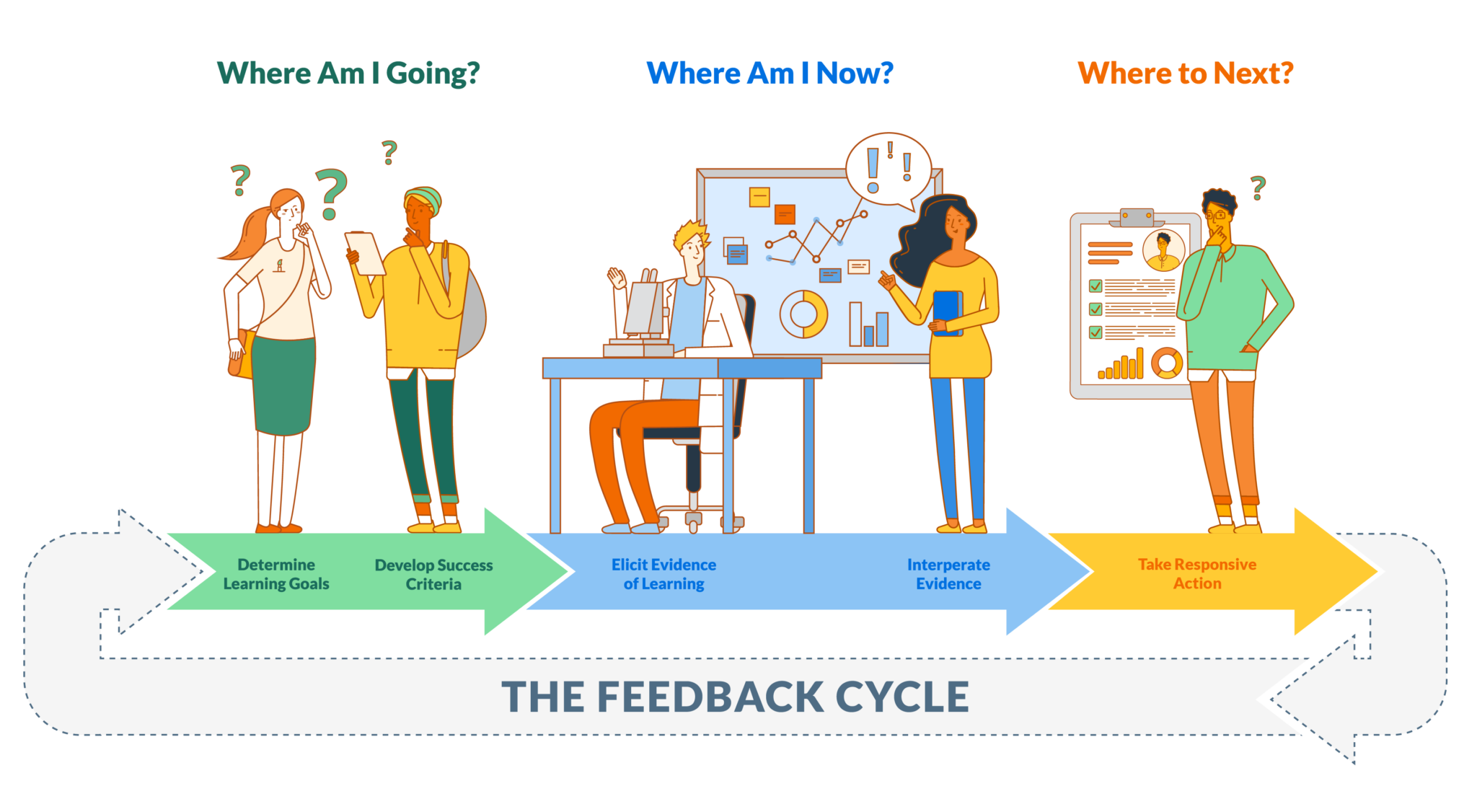
Simply put, a feedback loop is a continuous process in which an instructor provides feedback to students about their work. Then, the students use the feedback to improve their learning, and in turn, the faculty member adjusts their instruction based on the feedback. This dynamic creates a process for ongoing improvement and adaptation within the classroom environment.
Feedback loops established between students and faculty members are driven by three basic questions:
- Where am I going?
- Where am I now?
- Where am I going next?
Feedback loops are much more than just positive or negative reinforcement. They involve intentional processes that help students identify goals, evaluate and synthesize ideas, discuss their work constructively with others, and take actions to improve their performance. Engaged students also develop self-regulation, critical thinking skills, and practice a growth mindset (Zywica, 2023).
What are the benefits of feedback loops?
- Improved student learning – Constructive and structured feedback helps students identify areas for improvement and make adjustments accordingly.
- Increased student engagement – When students feel part of a process in which their own feedback is valued, they are more likely to remain engaged.
- Improved instructional effectiveness: An analysis of student feedback allows faculty members to identify potential areas for improvement that can be applied to future weeks, units, and courses.
What are some instructional strategies?
- Actively seek out and listen to feedback from your students as a feedback loop isn’t intended to be a one-way street. In addition to the agency the students will gain, this process can help you to tweak your instruction to better meet their needs, identify areas for improvement, and foster a more inclusive and engaging learning environment.
- Prioritize active learning in the classroom. Feedback is part of an iterative process in which students learn and develop skills, such as reflection, self-evaluation, and interpersonal communication. The feedback cycle itself can also be a form of active learning as students practice and improve upon these skills (Zywica, 2023).
- Focus on the formative! As a feedback loop requires students to interpret evidence of learning and take responsive action, they will need regular feedback throughout the semester. As a result, the use of formative activities and assessments that are tied to course objectives and evaluated using rubrics is advantageous.
- Clearly articulate the intended objectives and goals at the beginning of each lesson. When students understand the goals, it becomes easier for them to process your feedback and take corrective action.
- Encourage students to adopt growth rather than fixed mindsets (Puff, 2017). It can be the difference between a student feeling like this is “what I am” (e.g., I’m just bad at math) versus this is “what I can be” (e.g., Math might be hard, but I’m committed to improving).
- As an instructor, close the loop by reflecting on your aims. Examples of questions to explore include: Did students meet the desired learning of the day’s aim? Could they move to a different level of proficiency? Could they ask for more feedback? Are there any other areas to revise? (Meredith, 2015).
Resources
- Meredith, T. (2015, May 15). Starting Student Feedback Loops. Edutopia; George Lucas Educational Foundation. https://www.edutopia.org/blog/starting-student-feedback-loops-taylor-meredith
- Puff, R. (2017, September, 19). Growth Mindset vs. Fixed Mindset. Psychology Today. https://www.psychologytoday.com/us/blog/meditation-modern-life/201709/growth-mindset-vs-fixed-mindset
- Zywica, J. (2023). Moving Forward with Effective Feedback. Opportunity Education Foundation. https://opportunityeducation.org/wp-content/uploads/2023/04/OE_Moving-Forward-with-Effective-Feedback_vRGBFinal.pdf