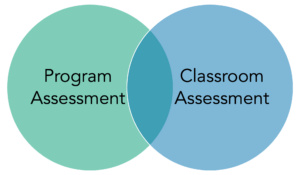
Program Assessment and Classroom Assessment are distinct teaching and learning topics. Program Assessment focuses on aggregate student learning where classroom assessment focuses on individual student learning and progress. However, a sampling of student work completed for Classroom Assessment is often used as evidence for Program Assessment, so there are points of convergence, too.
Let’s take a tangible example. Imagine, during Annual Program Assessment, that the faculty notice that, when persistence rates for the program are disaggregated by demographic characteristics, students who are first-generation in their family to attend college drop out of the program after sophomore year at a significantly higher rate than their peers who have at least one parent that completed a bachelor’s degree. The faculty the examine the courses at the sophomore level and note that there are some common pedagogical choices in course with higher DFW rates:
- Students’ final grades are primarily calculated from multiple choice exams.
- Students’ early attempts in the courses carry the same weight as later attempts and are averaged in the calculation of their final grade.
In this case study, through the Program Assessment process, the faculty identified two common examples of inequity in classroom assessment, and while they did not know for certain that these practices were causing students to drop out of the program, it is a reasonable consideration that shifting to more equitable classroom assessment practices could have a positive impact on the retention of first-generation students through the program.
It doesn’t take an “aha” identified through Program Assessment to implement equitable assessment principles. At VTSU, we have stated values to support this work, including this excerpt from the VSCS Diversity Statement: “We actively … break down barriers impacting access to education and professional growth for all.”
Here are some ideas for implementing equitable Classroom Assessment practices, drawn from Montenegro & Jankowski (2020):
- Implement Prior Knowledge Checks and then ensure they have appropriate baseline knowledge and skills to be successful.
- Reflect on how students’ social and cultural identities might influence learning and be assets in this assignment or class.
- Ask students what would best support their learning.
- Ask students to review learning outcomes, rubrics, and criteria for clarity and revise accordingly.
- Implement the Transparent Assignment Design template & process.
- Give students multiple ways to complete an assignment or express learning throughout the course.
- Incorporate drafts of assignments and build in revisions.
- Craft rubrics appropriate to the level of learning (e.g., introductory vs capstone), using developmental language.
- Interrogate standards and expectations: Is there bias in the assessment chosen (e.g., is it necessary for a presentation to be delivered orally, which might disadvantage some multilingual students or some students with learning disabilities)?
- Are you assessing social or cultural capital rather than learning?
- Consider whether your grading structure may promote inequities.
Reference
Montenegro, E., & Jankowski, N. A. (2020). A new decade for assessment: Embedding equity into assessment praxis(Occasional Paper No. 42). Urbana, IL: University of Illinois and Indiana University, National Institute for Learning Outcomes Assessment (NILOA).