In 1987, Chickering & Gamson published their seminal article “Seven Principles for Good Practice in Undergraduate Education.” If you haven’t (recently) read it, we would recommend taking a few minutes to do so, as the roadmap they laid out almost 40 years later still rings true. On the first page of their article, the authors note:
Good practice in undergraduate education:
- Encourages contacts between students and faculty.
- Develops reciprocity and cooperation among students.
- Uses active learning techniques.
- Gives prompt feedback.
- Emphasizes time on task.
- Communicates high expectations.
- Respects diverse talents and ways of learning.
Chickering & Gamson also cautioned that the integration of all seven practices is important for amplifying the power of any one of them. In this teaching tip, we’re going to focus on the importance of communicating high expectations to students (#6) recognizing the interplay with the other principles.
For instance, Kirby & Thomas (2022) utilized three tools to measure instructor behavior, classroom climate, and classroom community. They found that students engaged with high academic expectations when they not only perceived instructor competence as high, but also when they found instructors to be “caring, supportive, competent, and good communicators” (p. 375), a clear indication of both reciprocity and respect.
High Expectations Require High Support
In 1995, Scott & Tobe explicated the importance of how to effectively help students achieve high expectations through goal-setting activities, expectations of active engagement, and deliberate institutional support, as contrasted with a “weeding out” mentality. They delineated actions faculty could take to encourage students’ pursuit of high expectations, all of which are still salient today:
- define transparent criteria for assessments,
- create space in the curriculum for students to tailor activities or assignments to their personal interests,
- use exemplars to model excellent work,
- provide prompt feedback,
- recognize that higher education is a good place to make mistakes in the pursuit of knowledge with built-in multiple attempts, and
- celebrate successes with students.
To set students up for success in meeting our high expectations, it can be helpful to consider Lev Vygotsky’s concept of the Zone of Proximal Development (ZPD), proposed initially in the 1930s and enduring today (Flair, 2026). If there is gap between a learner’s skills and knowledge, then no quantity of high expectations will help them immediately be able to do a task. In other words, the high expectations require alignment with students’ development, coupled with appropriate support. The ZPD is facilitated by guidance, practice, and feedback to help a student build a bridge between their existing skills and knowledge (when learners can do tasks unaided) and their future competency.
Learner can do unaided.
Zone of Proximal Development:
Learner can do with guidance.
Learner cannot do.
Each learner in your classroom may have a different ZPD for any particular content or material you are teaching. Formative assessment and scaffolding (Office of Curriculum, Assessment and Teaching Transformation, n.d.), in which you begin with high levels of support and then fade the amount of support over time to increase independence, thus become critical.
Additionally, Self-Determination Theory (SDT indicates that students will rise to the challenge (by ascribing value to a task and consequently being more motivated) when they when “experience supports for competence, autonomy, and relatedness” (Deci & Ryan, 2000, p. 74). Again, faculty have a role to play. Providing students with early positive feedback, embedding choices, and creating opportunities for collaboration can boost intrinsic motivation toward achievement of high externally-set expectations.
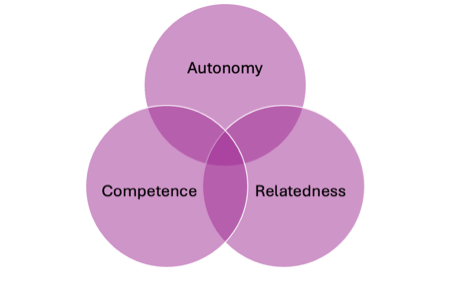
This emphasis on the responsibility of institutions and individual faculty for creating environments in which students can reach high expectations is echoed in Gannon’s (2023) more recent essay titled “Why Calls for a ‘Return to Rigor’ Are Wrong.” Gannon notes that rigor can fall into two categories: logistical and cognitive. He argues that higher education should be challenging (e.g., have high expectations for learning) while not enhanced by logistical barriers put up in the name of rigor.
Challenging Students Effectively
There are numerous ways to ensure that our classes are situated in students’ Zones of Proximal Development (ZPD), activate a sense of motivation and self-determination, and ensure positive learning challenge. We encourage you to try one or more of these approaches as you communicate high standards and support students to meet them.
- Communicate assignment expectations through transparently designed instructions and criteria, using exemplars when possible.
- Scaffold learning to boost students’ sense of competence and target their ZPD.
- Counter stereotype threat by teaching growth mindset.
- Implement team-based learning to increase relatedness.
- Learn one way to infuse choice in your courses (Nov 12 workshop) to increase autonomy.
If you would like assistance with any of these ideas, please don’t hesitate to reach out to us for a consultation!
References
Chickering, A. W., & Gamson, Z. F. (1987). Seven principles for good practice in undergraduate education. American Association for Higher Education Bulletin, 3-7. https://files.eric.ed.gov/fulltext/ED282491.pdf
Deci, E. L., & Ryan, R. M. (2000). Self-determination theory and the facilitation of intrinsic motivation, social development, and well being. American Psychologist, 55, 68 – 78.
Flair, I. (2026). Zone of proximal development (ZPD). Salem Press Encyclopedia.
Gannon, K. (2023, May 22). Why calls for a ‘return to rigor’ are wrong. The Chronicle of Higher Education. https://www.chronicle.com/article/why-calls-for-a-return-to-rigor-are-wrong
Kirby, L. A. J., & Thomas, C. L. (2022). High-impact teaching practices foster a greater sense of belonging in the college classroom. Journal of Further and Higher Education, 46(3), 368–381. https://doi.org/10.1080/0309877X.2021.1950659
Office of Curriculum, Assessment and Teaching Transformation. (n.d.) Scaffolding content. University of Buffalo. https://www.buffalo.edu/catt/teach/develop/build/scaffolding.html
Scott, R. A., & Tobe, D. E. (1995). Communicating high expectations: Effective undergraduate education. Liberal Education, 81(2), 38.