Note: This page is best viewed on a larger screen; it may be difficult to read on a mobile device or tablet.

An Overview of the PReCIP Report
Use the lefthand tabs or the next/previous links at the bottom of each page to navigate through a self-paced tutorial by the VTSU Center for Teaching & Learning Innovation focused on developing the Program Review & Continuous Improvement (PReCIP) report for the purposes of developing and submitting program review documents that fulfill the requirements of the Vermont State Colleges System Policy 101.
The Continuous Improvement Cycle
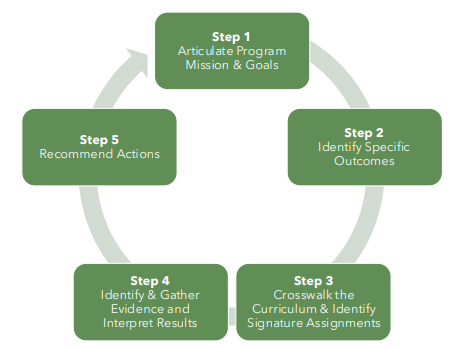
We engage in program assessment for continuous improvement and these five steps
represent the cycle that is followed. As part of the process, specific supporting
documents are developed and they contribute to the final PReCIP report, which is
due by June 1st of the fifth year of the cycle.
The PReCIP Report
What is the PReCIP Report?
The Program Review & Continuous Improvement (PReCIP) report is the final deliverable in the 5-year program assessment cycle. In addition to being the final deliverable, the PReCIP report addresses the goal of ensuring that VSC colleges regularly engage in practices designed to foster the improvement of academic degree programs as set forth in Policy 101.
Policy 101 requires those involved in delivering academic programs to periodically, systematically, and collaboratively review evidence regarding their effectiveness in achieving desired student learning outcomes and commit to making the changes needed to ensure continuous program improvement.
Do externally accredited programs submit the same information as internally reviewed programs?
Although all faculty members should be familiar with the PReCIP process, externally accredited programs do not submit the full report. These programs submit their most recent self-study, accreditation report, any interim reports since the last accreditation report, and an E-Series Form in the year the program is due for Program Review.
PReCIP Report Contents
What does the PReCIP report include?
- A student success and retention data review
- A student outcomes and assessment plan
- A program review
- A continuous improvement plan
- Supporting documents
Supporting docs include several of the files that were created and refined over the first 4 years of the program assessment cycle. Examples include the degree program map and milestones, the curriculum and learning outcomes crosswalk, and the program outcomes assessment matrix.
Part I: Student Success and Retention Data Review
The purpose of this section is to provide an analysis of the program from a data-driven perspective. For example, what percentage of students have been retained? What is the program’s graduation rate? Programs may also consider disaggregated data by prioritizing demographic groups (e.g., first gen students) and/or other priority data measures identified by the institution.
In addition, the section should include strategies for improvement. For example, if retention rates have decreased for all students or a sub-set of students, one strategy would be to implement additional planned outreach on the part of faculty, advisors, and academic support. Another strategy would be to see if there is a pattern in the timing of student withdrawals to help in determining if their greatest obstacles are occurring earlier or later in the program and then use the information for further investigation.
Part II: Student Outcomes and Assessment Plan
What are the goals of this section?
Present clearly articulated student learning outcomes (SLOs). SLOs should be mapped to a transparent program of study that communicates to students the critical sequences and milestones for on-time degree completion. In other words, the learning outcomes should clearly demonstrate what students need to know, do, or value in order to successfully complete the program and the curriculum should be designed to address those outcomes.
Integrate information from several contributing program assessment documents. Examples of contributing documents include the Degree Program Map and Milestones, Curriculum and Learning Outcomes Crosswalk, Program Outcomes Assessment Matrix, and E-Series form.
Present an assessment plan supported by direct and indirect measures. The selected direct and indirect measures should be distributed across a sustainable five-year cycle, through which faculty determine the extent to which the program achieves its goals for student learning and post-graduation outcomes. An analysis of the results on a summative assessment would be an example of a direct measure whereas the analysis of survey results would be an indirect measure.
Part III: Program Review
What are the goals of this section?
- Share the significant results and trends observed in the assessment data.
- Recommend specific strategies to improve student success and learning.
- Summarize specific feedback collected from program graduates.
- Share recommended curriculum revisions or other programmatic changes.
The intent of this section is to describe the program’s most recent cycle of program review and improvement efforts. It is a narrative that presents the findings/trends that emerged from the analysis of data collected over the previous four years of the assessment cycle, your recommended strategies for improvement, and the changes in curriculum that may be needed to address the findings/trends that emerged from the process.
The document should also include feedback from graduates that can potentially be collected via surveys and/or focus groups.
Part IV: Continuous Improvement Plan
What are the goals of this section?
- Present 1-3 goals identified through the PReCIP review.
- Explain how the goals will be accomplished.
- State the anticipated results from the achievement of the specific program improvement goals.
- Share any remaining improvement questions.
Faculty members use periodic reviews to reflect on past efforts and outcomes and to plan the continuous improvement of the program. It is recommended that faculty make the plan a collaborative effort rather than relying on a single department representative.
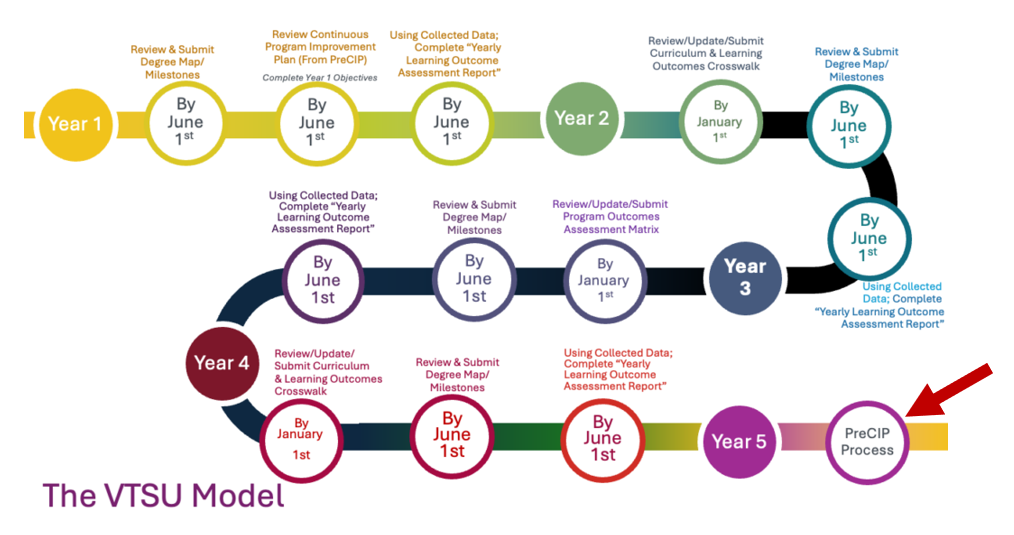
In years 1-4 of the assessment cycle, faculty leads submit an annual learning outcome assessment report by June 1st, which is used to assess a single program outcome per year. The data collected and analyzed as part of that yearly learning outcome assessment should contribute to the development of the goals identified in the continuous improvement plan.
It is important to remember that a continuous improvement plan is a living document that should regularly receive the collective attention of all faculty teaching in the program and the goals that have been identified should be the basis for continuous program improvement work over the next several years.
The Abbreviated Report
There is an abbreviated version of the PReCIP report that should be completed by programs that are due for PReCIP in 2026-27 and 2027-28. Programs included in those review years are working in a shorter than normal cycle, which will impact the Continuous Improvement Plan section. The full version of the PReCIP report will be used in 2028-29 and beyond.
What are the requirements for the abbreviated report’s Continuous Improvement Plan section?
The narrative should be kept to 2-4 pages in length and include the following:
- Describe 1-3 goals identified through the past 2-3 years of annual program assessment (since 2024) that will drive continuous program improvement work over the next several years.
- How will these goals be accomplished via the next five years of the program’s specific assessment activities, as outlined in the Program Outcomes Assessment Matrix?
- What specific improvements in student success and learning outcomes, as demonstrated by future assessment results, would you anticipate as a result of achieving these specific program improvement goals?
- What are the program improvement questions you have? What are your preliminary thoughts on how and when you might pursue these questions? For example, what data would you need to help you answer each question?
Submission Deadline
When is the Yearly Learning Outcomes Assessment Report Submitted?
The report is due by June 1st in the fifth and final each year of the continuous improvement cycle as shown in the VTSU Program Assessment Model.
The PReCIP Report Template
Is the use of a template a requirement?
Yes, and a Word-based copy of the report template is available on the VTSU Program Assessment SharePoint site. It is formatted based on the requirements of the Chancellor’s Office and should be used by all VTSU programs that are not externally accredited.
Once you’ve accessed the site, scroll to the Important Links section and select the Assessment Docs – Templates button. Then, download a copy to get started. As previously mentioned, programs up for review in 2026-27 and 2027-28 should use the abbreviated version.
Examples of Completed Reports
Are there examples of previously submitted reports?
Yes, PDF-based exemplars from prior years are on the VTSU Program Assessment SharePoint site.
Once you’ve accessed the site, scroll to the Important Links section and select the Assessment Docs – Examples button. Then, review examples previously submitted by your faculty colleagues.
Submitting the Report
How is the PReCIP Report submitted?
Navigate to the VTSU Program Assessment SharePoint site and scroll to the Program Assessment Documents section. Then, select the Submit Required Documents button.
The resulting form is used to attach the completed PDF document, and the submission will automatically be forwarded to the applicable program coordinator or dean to review. The report submission is part of a structured workflow. Do not submit the file(s) by email or any other means.
Program Assessment Support
Is there support available?
Yes, there is support available for the program assessment process.
Consulting with a group of faculty colleagues is a great place to start and one recommendation is to schedule a formal meeting, series of meetings, and/or departmental retreat to address program assessment.
In addition to faculty colleagues, there are campus partners who are available to provide additional support and program assessment leads are encouraged to:
- Consult with the Center for Teaching & Learning Innovation
- Access institutional data on the Institutional Analytics SharePoint site
- Contact Institutional Research with additional data-related questions and requests